


The harness directly affects the user experience and passenger safety. The appearance of four-point, five-point, and 6-point harness is similar, but there are significant differences in practical use. This article will give you a detailed introduction to these three types of harnesses and help you choose the most suitable product for you.
What Is The Harness?
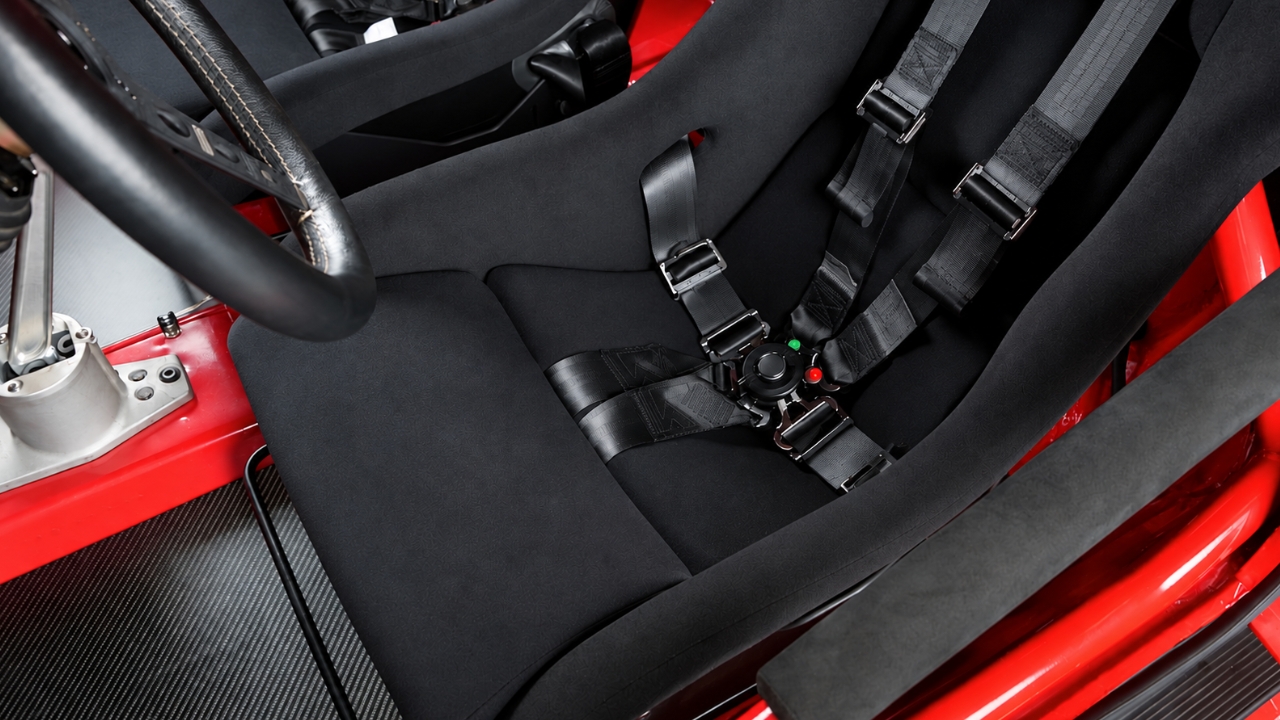
The harness refers to multi-point restraint seat belts. It is different from the common two-point and three-point seat belts. It firmly fixes the upper body and pelvis of the passenger to the seat through multiple straps.
Because of its complex structure, it is usually used in conjunction with a central quick-release buckle. It is widely used in racing cars, off-road vehicles UTV、 In scenes such as karting.
 What’s The Difference?
Although all three types of harnesses can protect passengers, there are differences in their structure, effectiveness, and application.
Quick Comparison Table
| Aspect | 4-Point Harness | 5-Point Harness | 6-Point Harness |
| Structure | Shoulder straps+double waistbands, no crotch straps | Shoulder strap+double waist strap+mid single anti-submarining crotch strap | Shoulder straps+double waistbands+dual anti-sub straps |
| Anti-submarining capability | Weak, with significant submarine effect risk | Strong and effective in preventing the body from slipping and slipping | Extremely strong, double-layered bottom protection, with negligible pelvic displacement |
| Fixed effect | Only fixes the upper body; easily shakes when bumped | Full body fixation, excellent stability | Full fit locking, almost no displacement during high-speed/rolling |
| Security level | Basic civilian grade | Off road/modified universal grade | Professional competition level |
| Applicable scenarios | Sightseeing car, golf cart, forklift, low-speed UTV | Off-road UTV, off-road vehicle, civilian modification, sand vehicle | Professional racing, extreme off-road, and professional racing vehicles |
| Installation difficulty | Simple, universally adaptable, and low cost of modification | Suitable for both medium and regular seats | High, requiring professional seating and precise alignment installation |
| Cost | Lowest and most cost-effective | Moderate, with the most balanced performance and price | High-end positioning, high-end positioning |
Structure
4-Point Harness: The 4-point harness has four anchor points. It consists of two shoulder straps and two lap belts, with four straps converging at the central buckle. It doesn’t have a crotch strap.
Compared with the 5-point harness and the 6-point harness, its structure is the simplest. It is also the most easy for putting on and take off. And because of its fewer structural components, its failure rate is also lower. If you don’t have high requirements for the safety performance of a harness, you can choose it.
5-Point Harness: The 5-point harness is a five-point layout. It adds an anti-submarine strap to the 4-point harness. The design is “double shoulder, double waist, single crotch”. One section of the anti-submarine strap is fixed to the bottom of the seat or floor anchor point, and the other end is connected to the lock buckle.
The force points of it are evenly distributed, the restraining force is stable and reliable, and it is suitable for the vast majority of high-intensity civilian scenarios.
6-Point Harness: A 6-point harness adds two anti-submarine straps on top of a 4-point harness. Unlike the five-point crotch strap, its two anti-submarine straps extend from both sides of the pelvis, usually in a V-shaped or Y-shaped distribution, fixing both sides of the pelvis simultaneously.
Although the structure is complex, its safety is the best. If you need a high-security harness, then you should choose it.
Physical Restraint
4-Point Harness: The 4-point harness uses two shoulder straps to press the passenger’s torso towards the seat and a lap belt to secure the pelvis.
But because it does not have an anti-submarine strap, there is no downward tension in the locking position. So during rapid deceleration, the passenger’s upper half of their body will arch forward along the seat, and there is also a possibility of the belt moving up.
The restraint performance of a 4-point harness is the weakest among these three types of harnesses.
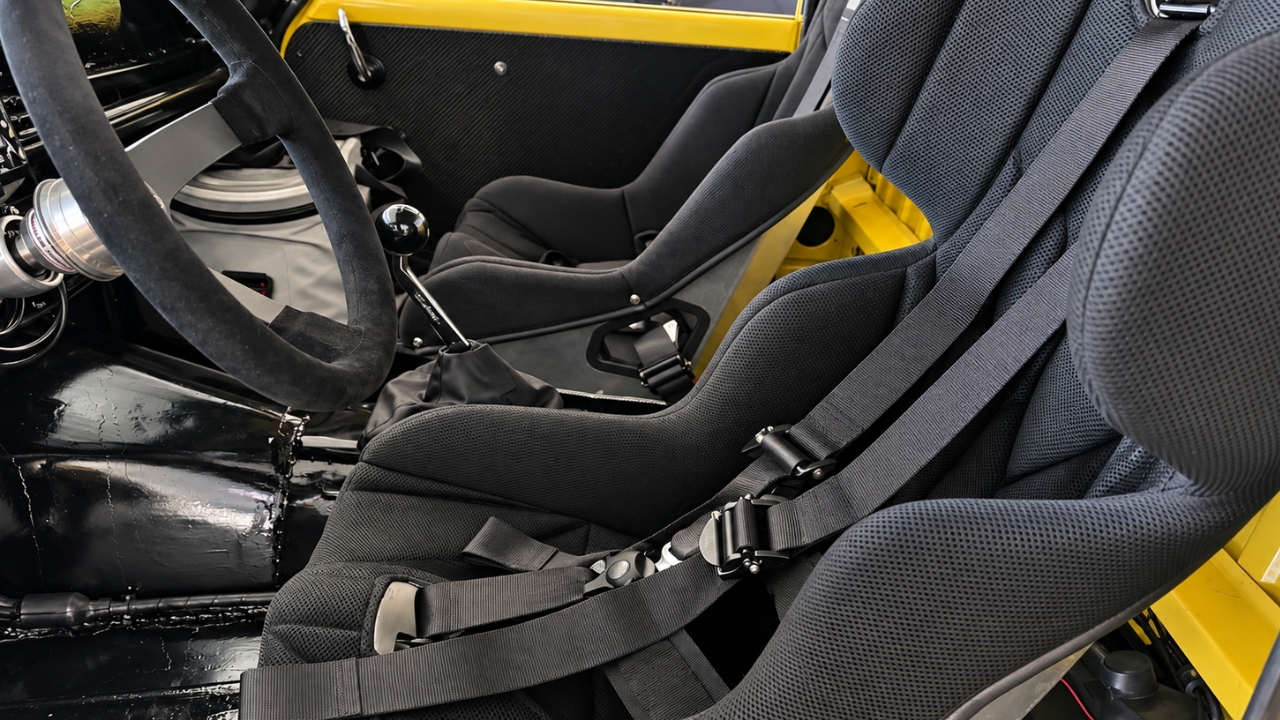
5-Point Harness: The 5-point harness, due to the addition of an anti-submarine strap, can firmly secure the lap belt. Therefore, the 5-point harness can help you enhance the restraint on the passenger’s torso and pelvis.
6-Point Harness: A 6-point harness fixes the passenger’s pelvis from both sides simultaneously through two anti-submarine straps, providing a more even distribution of restraining force. And during the driving process, control of the passenger’s body swinging in the left and right directions is also better. During high-speed turns and continuous lane changes, it can maintain the stability of passengers’ body posture.
 Anti-submarining Capability
Submarining refers to the process in which, during a frontal collision or sudden braking, the passenger’s body slides forward and downward along the seat due to inertia. It is a key form of accident prevention in harness design.
If submarining occurs, the lap belt may slip over the hip bone and enter the abdomen, which may cause serious internal organ damage. At the same time, the passenger’s head may lose restraint and collide with the steering wheel.
The anti-submarine strap is to solve this problem. It pulls down on the buckle and lap belt to keep the belt pressed against the pelvis, thereby preventing the body from sliding out from under the belt.
- 4-Point Harness: A 4-point harness has no anti-submarine strap to resist submarining, so it does not have the ability to prevent submarining. As a result, most mainstream venue events do not accept 4-point harnesses.
- 5-Point Harness: A 5-point harness features a single-center anti-submarine strap. It can effectively prevent the occurrence of submarining. However, it should be noted that a single-center anti-sub strap may shift under heavy asymmetric lateral loads, especially with improper installation or poor seat geometry.
- 6-Point Harness: The two anti-submarine straps of a 6-point harness can fix both sides of the passenger’s pelvis simultaneously. It performs most reliably in extreme, multi-directional changes and long-term load scenarios. It is widely recognized as the most thorough structure for preventing submarining.
If you want to improve the safety of passengers or enhance the safety performance of products, it is best to choose a harness with anti-submarine belts.
Application
4-Point Harness: A 4-point harness is commonly used in off-road crossing, drift practice, classic racing events, go-karting, and various special vehicles. If your product has low requirements for safety performance and pursues simplicity and cost-effectiveness, then it is a good choice.
5-Point Harness: A 5-point harness is the mainstream choice for club events, entry-level track racing, off-road racing, and UTV modification. It can help you pass the technical inspections of most racing organizations.
6-Point Harness: A 6-point harness is commonly used in professional track racing, endurance racing, WRC, and Formula racing, as well as high-speed straight-line acceleration races.
If your product requires the highest level of safety and long-term comfort, you should choose it. In long-distance races, the two anti-submarine straps of a 6-point harness can disperse pelvic pressure and reduce driver fatigue.
Installation Complexity
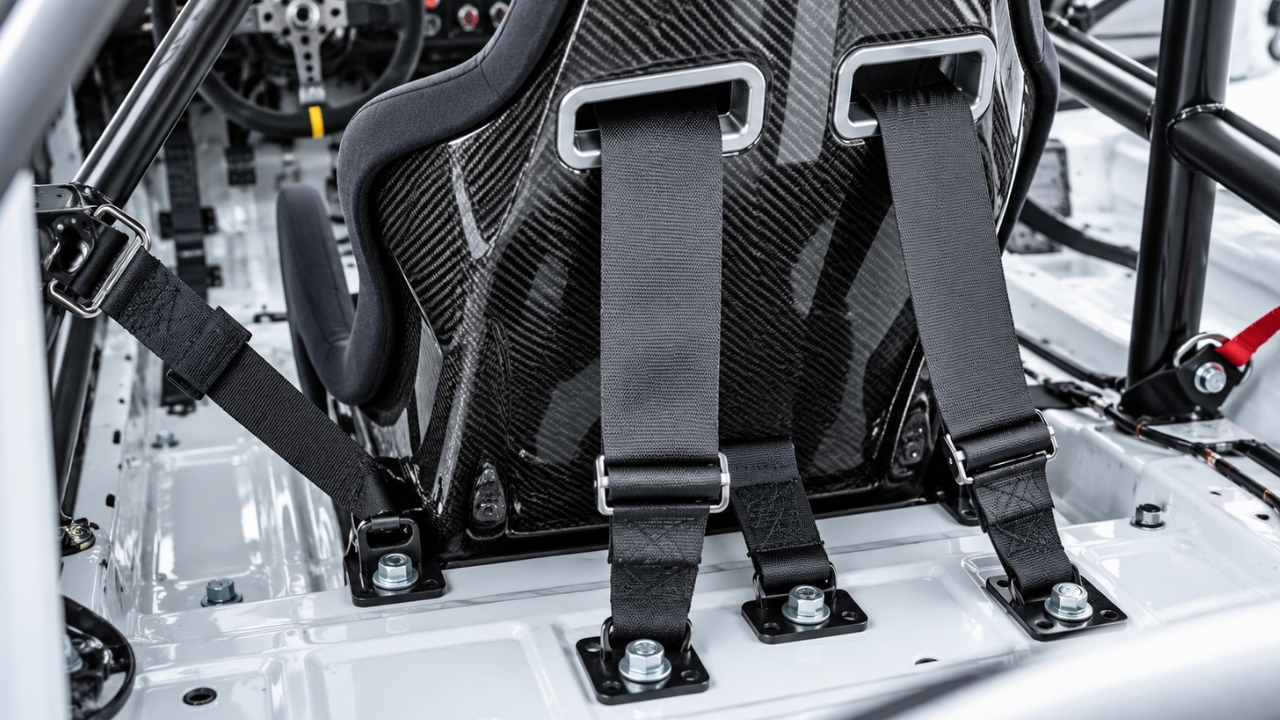
The more anchor points there are, the more complex the installation of the harness becomes. 4-point harness has only four anchor points, which are usually fixed to the vehicle body or seat. 5-point harness requires adding an anchor point for the anti-submarine strap. 6-point harness requires adding two anchor points for the anti-submarine strap.
The fixed position of the anti-submarine strap is usually the bottom of the seat or the floor. If your car model is equipped with bucket seats, you usually need to reserve openings or install brackets. The two anti-submarine straps of a 6-point harness have higher requirements for seat openings and fixed structures.
 Which Is The Best For Your Product?
The choice of harness requires consideration of multiple aspects. It is not advisable to blindly pursue cheap or high-end products. You should choose the products that are most suitable for you.
Certification Standard
Whether the harness meets the standards directly proves whether the product is safe. When choosing a harness, you must ensure that the product you choose meets certification standards. The following certification standards are available for your reference.
- FIA 8853-2016: It is the current seat belt certification standard of the International Automobile Federation, covering structures with 6 points or more (two anti-submarine straps), and the certification is valid for 5 years.
It requires the harness to pass dynamic sled collision tests and webbing tensile strength tests, and the six anchor points must be independently fixed to the main structure of the vehicle or certified roll cage.
Each anchor point must withstand a static load of not less than 14kN. Starting from 2023, race vehicles that comply with FIA Appendix J are required to use the harness certified according to this standard.
- SFI 16.1: This is the mainstream certification in North America. It covers a 5/6 point structure, and the required tensile strength of the webbing is not less than 6300 pounds (approximately 28kN).
- SFI 16.5: It adds tests such as webbing wear resistance on the basis of 16.1, with higher requirements for fracture strength (about 31kN), and is mostly used for track racing.
The certification standards may vary in different regions. Before purchasing products, it is best to have a detailed understanding of the certification standards to avoid problems caused by incorrect selection.
Application Scenarios
Before choosing a harness, you need to clarify the type of your product. Different cars and events have different requirements for the structure and certification of the harness.
| Scenario | Harness | Reason |
| Venue racing (club events) | 5-Point Harness | Can pass most technical checks, balancing safety and cost |
| Track racing (professional/endurance) | 6-Point Harness | FIA 8853-2016 certification, the most thorough anti-submarining |
| Rally car | 6-Point Harness | The International Automobile Federation regulations require dual anti-submarine straps to handle complex loads |
| Off-road vehicle/UTV (non-certified use) | 4-Point Harness/5-Point Harness | Easy to install, low cost, and suitable for daily use |
| Off-road racing | 5-Point Harness/6-Point Harness | Balancing anti-submarine and long-term comfort |
| Drift practice car | 4-Point Harness/5-Point Harness | Entry-level selection, confirmed according to the competition rules |
| Kart | 4-Point Harness/5-Point Harness | Must comply with the special constraints and standards for karting |
Cost
From the perspective of procurement costs, a 4-point harness has the lowest price, while a 6-point harness has the highest price. Each additional anti-submarine strap means more webbing, metal adjusters, buckle components, and certification testing costs.
But when choosing a harness, one cannot only consider the price of the product. You should consider different requirements comprehensively. If there are strict standard requirements, you should increase your budget appropriately for your products.
Supplier
The strength of the supplier directly determines the quality of the harness. A reliable supplier can provide you with high-quality products. When inspecting suppliers, you can focus on judging their certification documents, processes, customization capabilities, supply capabilities, and after-sales systems.
BXseatbelt has a complete production system and an after-sales service system. We can provide you with factory and product certification documents. We are committed to providing customers with high-quality products and services, so that you have no after-sales concerns.
 FAQ
What Material Is The Racing Harness Made Of?
The mainstream harness usually uses polyester webbing, with a shoulder strap width of 75mm. Some lightweight harnesses that are used in conjunction with head and neck restraint systems use a 50mm style. BXseatbelt’s harness comes in three standard sizes: 45mm, 50mm, and 75mm, and you can choose according to your needs.
The material used for our adjuster hardware is mostly 45 steel, so the quality of our adjuster hardware is also better than products made of aluminum alloy.
Can BXseatbelt Customize Harnesses For Different Cars?
Yes. BXseatbelt has extensive experience in customization. We can customize different car models such as UTVs, go-karts, and modified racing cars.
We can adjust the length of the webbing, anchor installation holes, and webbing direction based on the position of the body anchor points, seat structure, and cabin space. In addition, we can help you customize the webbing color, adjustment parts, logo printing, and packaging methods.
What Is The Lifespan Of A Harness?
The service life of a competitive harness is related to many different factors, such as certification standards and manufacturer requirements, and so on.
The seat belt certification of FIA 8853 is valid for 5 years, while the harness certification of SFI is valid for 2 years. When the seat belt expires, even if the appearance is intact, it cannot continue to be used for professional activities.
In addition, in the event of a collision or rollover accident, regardless of whether the appearance of the harness is damaged or not, it must be replaced immediately.
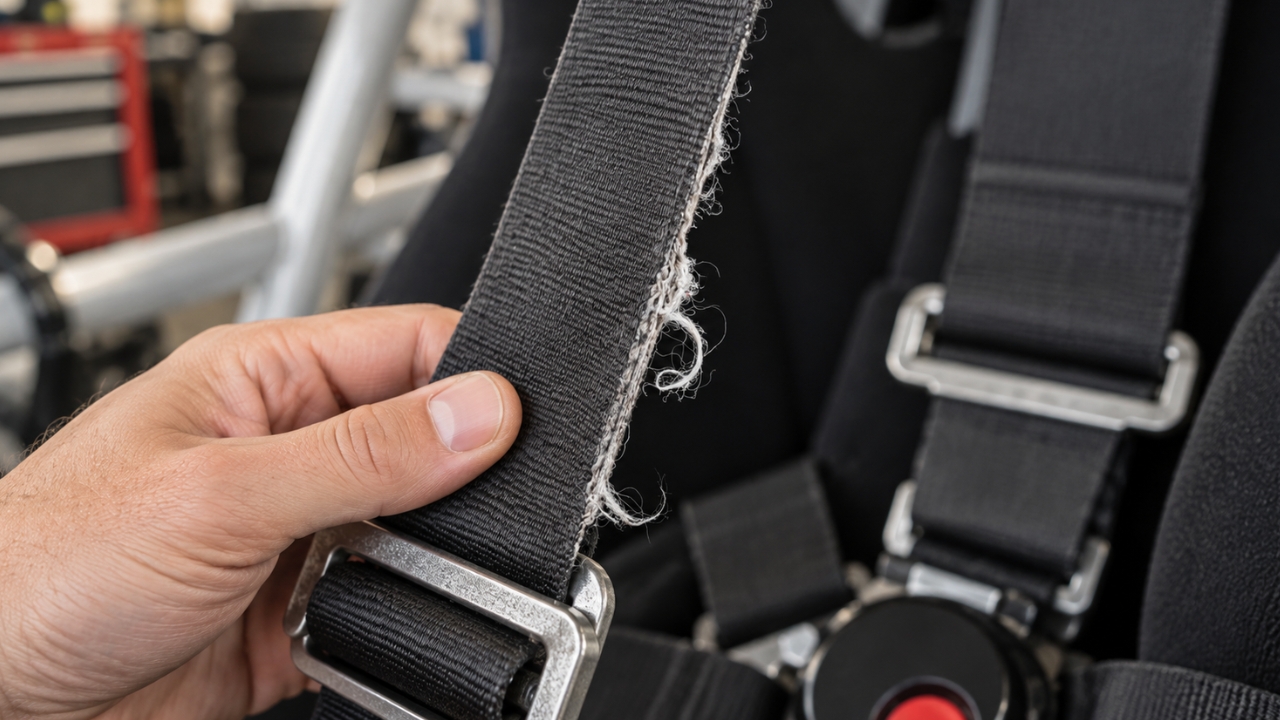
If there are cuts, pilling, fading, or aging of the webbing during daily use, or if the hardware buckle is deformed or corroded, it also needs to be replaced immediately. If it is only for daily civilian use, we also recommend that you regularly check the harness and replace aging products.
 Can Different Brands Of Webbing And Locking Accessories Be Mixed?
It is not recommended to mix lock buckles, webbing, adjusting hardware, and other components across brands.
Mixing components cannot guarantee the performance of the product, and the original certification of the product will also become invalid. In severe cases, it may lead to safety accidents. If the parts are damaged and need to be replaced, we recommend that you use original replacement parts of the same model from the factory.
How Does The Material Of The Webbing Affect The Performance Of The Harness?
Webbing is the core component of seat belts. Its material directly determines the tensile strength, wear resistance, and anti-aging performance.
The mainstream choice for racing seat belts is polyester webbing. It has the advantages of high tensile strength, UV resistance, and aging resistance. Nylon webbing is rarely used in racing scenes due to its high elongation. Poor-quality webbing is prone to breakage and fuzzing. It may cause safety risks.
BXseatbelt’s webbing is made of high-quality materials, so you don’t have to worry about quality issues. We also support customizing materials for webbing.
Can You Use A 6-Point Harness As A 4-Point Harness?
In theory, it is possible. If you only use the two shoulder straps and two waist belts of a 6-point harness, leave its two anti-submarine straps unused. Then it can temporarily serve as a 4-point harness.
But we do not recommend that you do this. If the anti-submarine straps are not properly stored and fixed, they may cause potential risk during vehicle operation. The protective effect of the 6-point harness will also decrease. If you need a 4-point harness, we recommend you choose a compliant 4-point harness instead of modifying a 6-point harness.
Final Thought
There is no absolute goodness or badness for the four-point, five-point, and six-point harness, only suitability or unsuitability. BXseatbelt has been engaged in the research and manufacturing of harnesses for many years and has rich experience. If you want to purchase a high-quality harness, please feel free to contact us.