

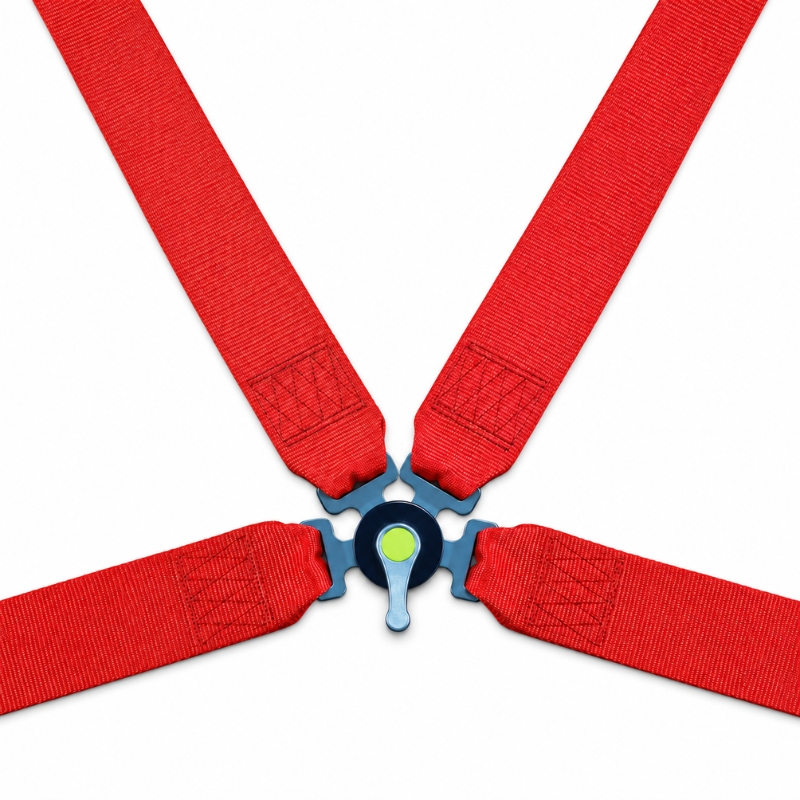


Features of Our Racing Harness
- Multi-point restraint for track driving and motorsports
- Mounting options support different racing seats and vehicle setups
- Anti-submarine strap helps prevent driver submarining
- Adjustable racing harness straps for driver and seat fit
- Flexible MOQ, starting from 50 pcs for racing harness orders
- Pre-production samples for racing seat fitment approval
Your Trusted Racing Harness Manufacturer in China
BXseatbelts Racing Harness is a high-performance multi-point safety system designed for racing cars, custom off-road builds, and popular UTV / SxS platforms (such as Polaris RZR, Can-Am Maverick, and Yamaha YXZ) equipped with roll cages or harness bars. As a racing harness supplier, we offer products designed for installation on vehicles equipped with roll cages, harness bars, or other suitable mounting structures.
If you already have your own racing harness design, we can help you develop a custom model through OEM/ODM services. Which parts can be adjusted depends on your project requirements, such as point configuration, buckle type, webbing width and length, and installation method. Additionally, webbing colors, logos, brand labels, and retail packaging can be customized to meet your brand requirements.
Before placing bulk orders, BXseatbelts can prepare samples for you to check the actual fit of the product. After the sample is confirmed, bulk production of the racing harnesses is arranged according to the final specifications to reduce subsequent rework and lower trial-and-error costs in your procurement process.
Types of Racing Harnesses
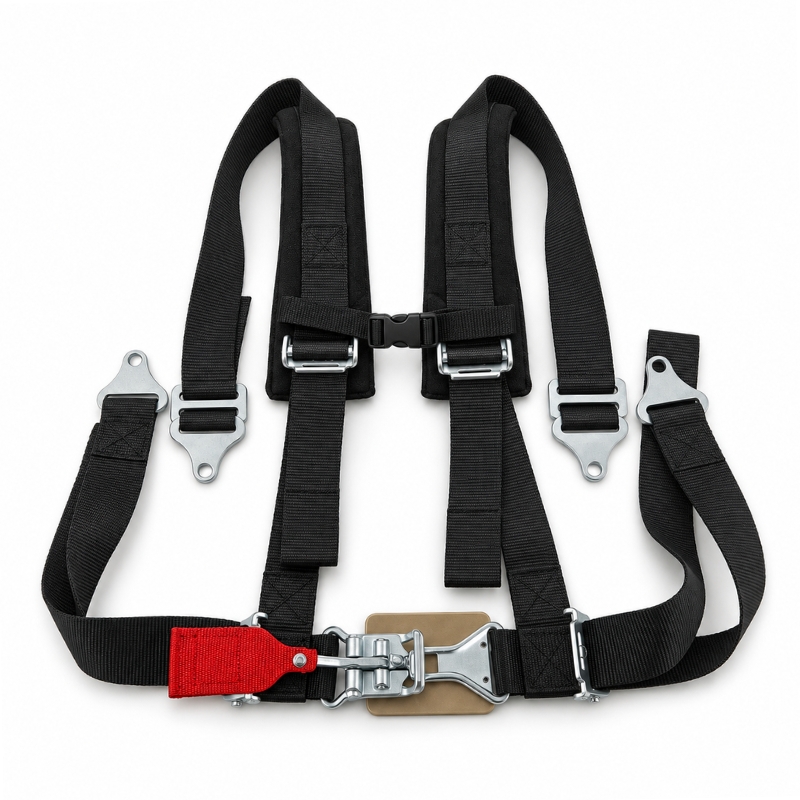
This configuration is commonly seen in racing and off-road vehicles. It uses two shoulder straps and two lap straps to form a four-point setup.
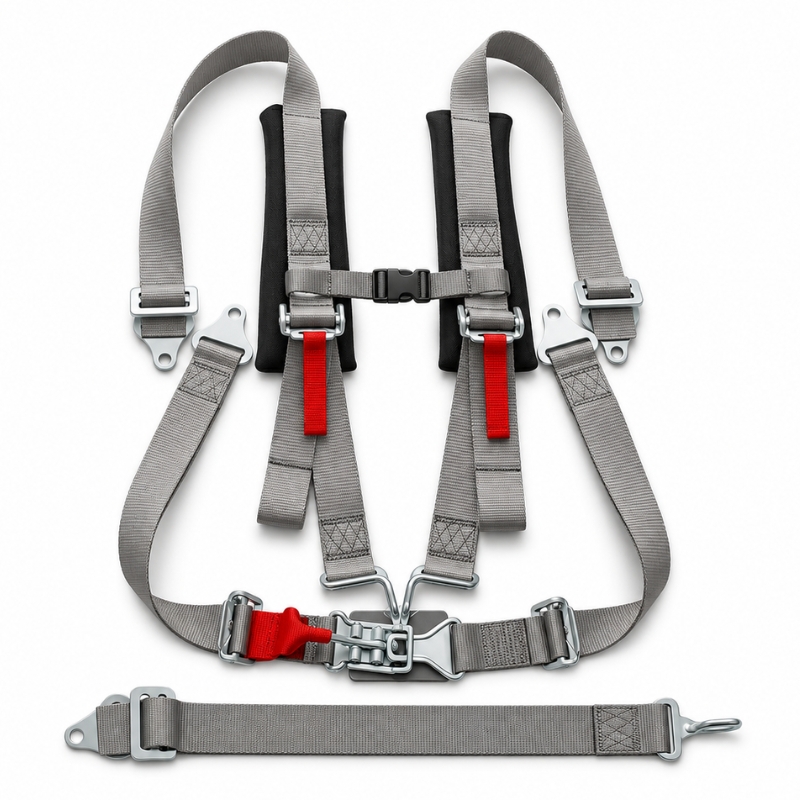
An independent anti-submarining crotch strap prevents the driver from sliding under the lap belt during front impacts.
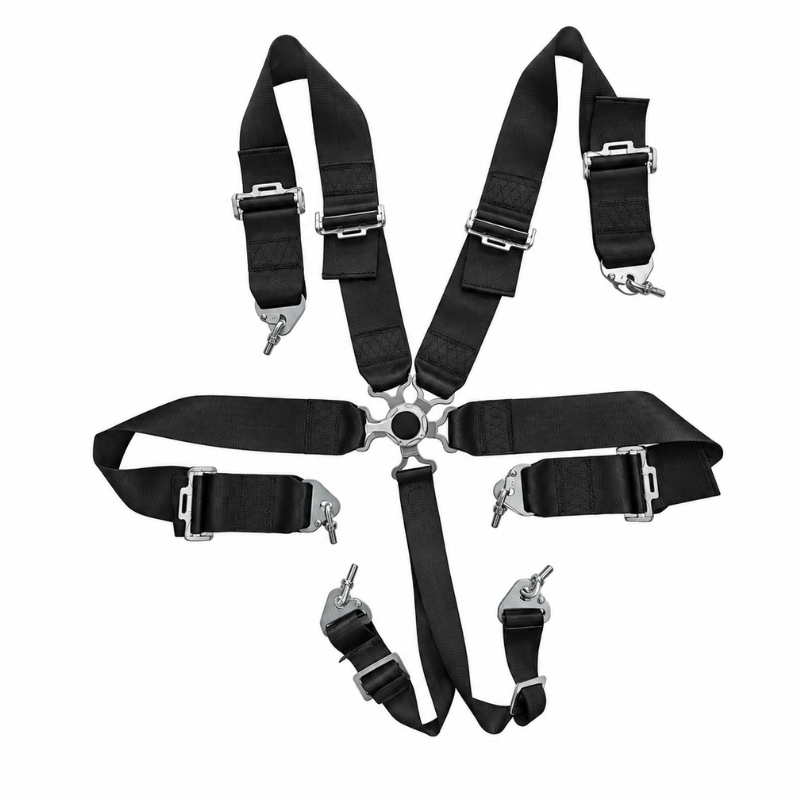
This method is straightforward when the vehicle already has suitable mounting points. The harness straps are secured to the corresponding locations with bolts.

The straps are wrapped around a suitable mounting bar or structure during installation. It can be considered for compatible setups that do not use direct bolt-in mounting.

Hooks are used to connect the harness straps to compatible mounting points on the vehicle.
Buckle Customization Options We Offer
 Camlock Buckle
Camlock is a practical choice when quick release matters. It is commonly used with racing and off-road harness configurations.
 Latch & Link Buckle
This buckle uses a latch-and-link structure with straightforward operation. It can be selected according to the requirements of different Racing Harness projects.
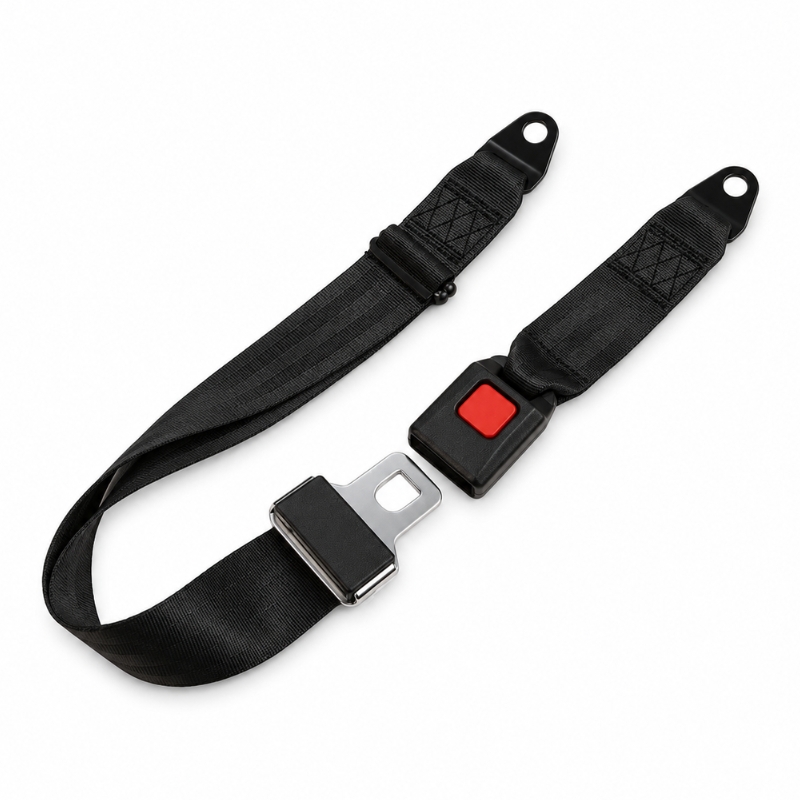 Push-Button Buckle
Release is handled by a simple push-button design, making the operation easy to understand. The choice can depend on the vehicle structure and overall harness configuration.
Racing Harness Specification
| Item | Specification |
| Product Type | Multi-Point Racing Harness |
| Point Configuration | 4-Point / 5-Point |
| Buckle Options | Camlock / Latch & Link / Push-Button |
| Mounting Options | Bolt-In / Wrap-Around / Hook-Style |
| Webbing Material | High-Strength Polyester |
| Webbing Width | 1.75″ (45mm) / 2″ (50mm)/ 3″ (75mm), including optional 3″-to-2″ tapered shoulder straps designed for HANS / FHR device compatibility. |
| Strap Length | Adjustable |
| Stitching | Reinforced Box-X Stitching |
| Adjusters | Available with heat-treated 45 steel adjusters |
| Crotch Strap | Independent anti-submarining strap for 5-point configuration |
| Hardware | Corrosion-Resistant Metal Hardware |
| Mounting Hole | Approx. 11.5–12 mm; final dimensions to be confirmed |
| Thread Standard | 11.5–12 mm mounting holes matching 7/16″ Imperial thread bolts |
| Quality System | IATF 16949 |
| Testing / Compliance Support | E-Mark / ECE R16 available on select models; FMVSS 302 flammability test report for specified webbing materials, where available. |
| Packaging | PE Bag / Color Box |
| MOQ | 500 pcs / style (Trial orders accepted from 50 pcs) |
How to Choose the Right Racing Harness for Your Vehicle
Start with the Application
If you are involved in racing, off-road modification, and UTV/SxS accessories businesses, do not treat racing seat belts as generic products. Seats, roll cages, harness bars, and installation locations may vary between vehicles.
Once customers determine the vehicle model and modification plan, the number of seat belt points, fixing accessories, and installation method are also easier to determine. If a vehicle model is purchased according to a common configuration before it is determined, there may be inventory backlog or difficulty in adapting the product.
If you have a large number of customer types, you can first categorize them by main application scenarios, and then determine the configurations commonly used by each type of customer. This makes it easier for you to determine which product set is suitable for which type of customer when making subsequent quotes and return orders.
Match the Mounting Setup
There’s no need to rush to judge which installation method is better. First, check if there are corresponding fixing points on the car. This is the most practical approach.
If the original car comes with its own fixing base, the bolt type is suitable; if the car has a crossbar for easy winding and fixing, the wraparound type will be more suitable. In addition to the fixing method, remember to check the hole position, thread specifications, and installation spacing of the vehicle body base.
For suppliers developing custom fitments for tuner shops or specific vehicle models, obtaining a prototype sample for test installation minimizes fitment discrepancies and prevents costly bulk revisions. If it’s even a few millimeters off, it might get stuck between the seat and the roll cage and not fit.
Pick the Right Buckle
Camlock buckles, Latch & Link buckles, and Push-Button buckles are each suitable for different use scenarios. When discussing requirements with customers, you can first ask which type they usually use, rather than simply comparing styles.
If your existing retail customers prefer a specific buckle design, changing hardware configurations prematurely may affect user habits and require re-fitting by installation shops. Aftermarket tuners and installation shops would need to re-verify hardware clearances, increasing after-sales complexity.
If you plan to create your own brand, you can set the fasteners during the proofing stage. After the sample is finalized, subsequent return orders will all follow this configuration, which will better control product stability.
Check the Webbing Width
The available webbing widths are 45 mm, 50 mm, and 75 mm (approximately 1.75 inches, 2 inches, and 3 inches, respectively). The final choice should be based on the seat structure and overall harness configuration.
The right width depends not only on the seat opening but also on the available space around the adjusters and the intended strap routing. If the webbing is too wide, it may rub against the seat wings and roll cage brackets, leading to faster wear over time. For OEM/ODM projects involving specific vehicle models, these potential fit issues can be identified during sample fitting.
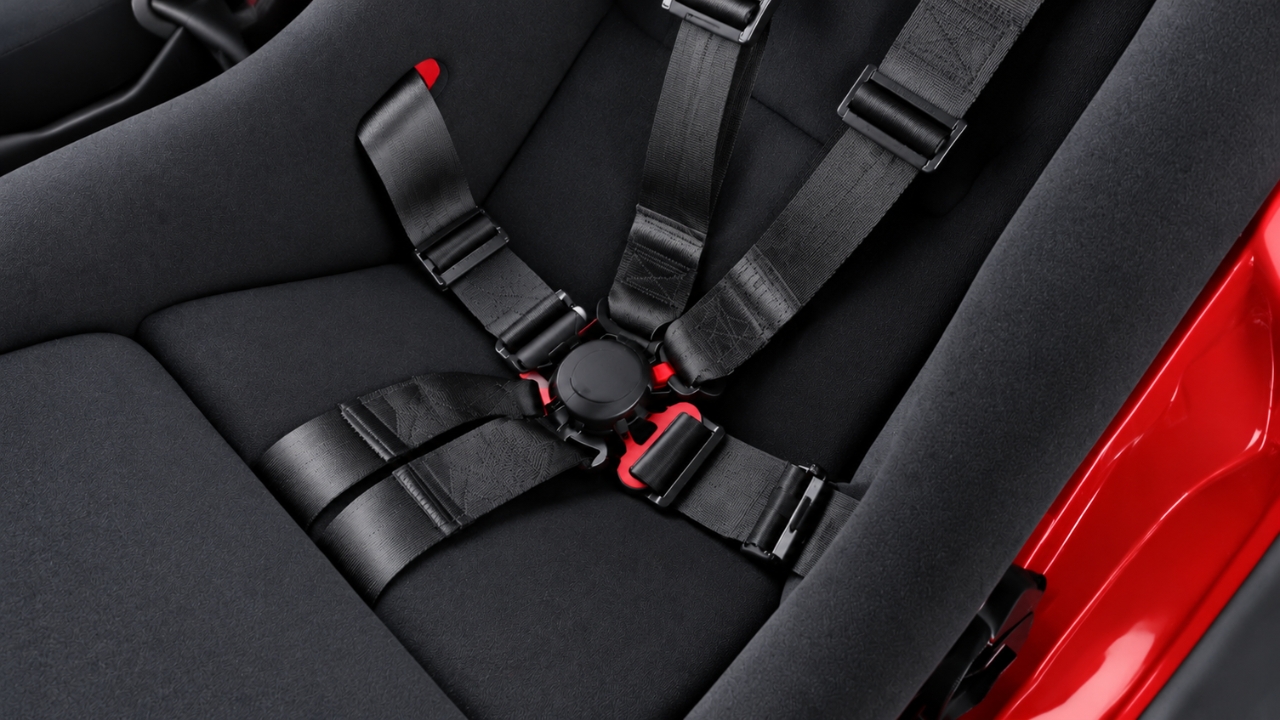 Racing Seat Belt Quality Control
From the arrival of raw materials at the factory to production, assembly, and shipment, every step of the racing seat belt manufacturing process affects the quality of the finished product. For long-term orders, you cannot focus only on the first batch of products. Whether different batches maintain consistent specifications also directly affects your inventory management and after-sales workload.
Incoming Material Inspection
After webbing, fasteners, adjusters, and other hardware accessories arrive at the factory, their materials and specifications need to be verified before they enter production. Webbing is mainly checked for color, width, and surface condition, while hardware accessories are checked for type, specifications, and physical condition. Materials that do not meet the requirements cannot be put into production.
As orders continue to be repeated, subtle differences in materials may gradually become apparent. For example, color variations in the webbing or changes in hardware versions may not be easy to notice when only a small number of products are compared. However, after several batches have been received into inventory, these differences may become much more obvious. Therefore, in addition to checking whether the materials meet the requirements, incoming material inspection should also compare them against the confirmed specifications and check for consistency between batches.
In-Process Inspection
Webbing cutting, sewing, and hardware assembly are all production stages that require inspection. Deviations in webbing length, Box-X stitching that does not match the confirmed sample, or hardware components installed in the wrong direction or position are best identified during production. Reworking products after an entire batch has been completed is more difficult and also increases time and material costs.
For OEM/ODM orders, production should follow the final approved samples and specifications. Details such as point configuration, buckle type, and webbing specifications must follow the confirmed version to avoid differences between the finished products and the original customized requirements.
Finished Product Inspection
After assembly, the actual operating condition of each seat belt also needs to be checked. The buckle should be operated repeatedly to confirm that it locks and releases properly. The adjuster should be moved back and forth to check whether it operates smoothly. Stitching and assembly details at each connection point must also be inspected individually. Product conformity cannot be judged by appearance alone.
If your order uses special fasteners, custom webbing, or other exclusive designs, each item must be inspected against the final confirmed specifications. Inspection standards for other models should not be applied directly.
Pre-Shipment Inspection
Passing the quality inspection as an individual product does not mean that packing will be free of errors. Incorrect point configurations, buckle types, webbing colors, or packaging that do not match the order requirements can disrupt your stocking schedule or even affect project progress.
Therefore, before shipment, the final order details should also be checked. This includes the number of seat belt points, buckle type, webbing width and length, color, labels, and packaging to ensure that the actual shipment matches the confirmed order specifications.
Sample and Specification Records
The samples and specifications approved for the first order should be properly retained, including the point configuration, buckle type, webbing specifications, color, and packaging requirements. For repeat orders, production can refer to these records without having to confirm every detail again. If any specifications are adjusted, the records should be updated promptly, with old and new versions clearly distinguished to prevent outdated specifications from being used in production.
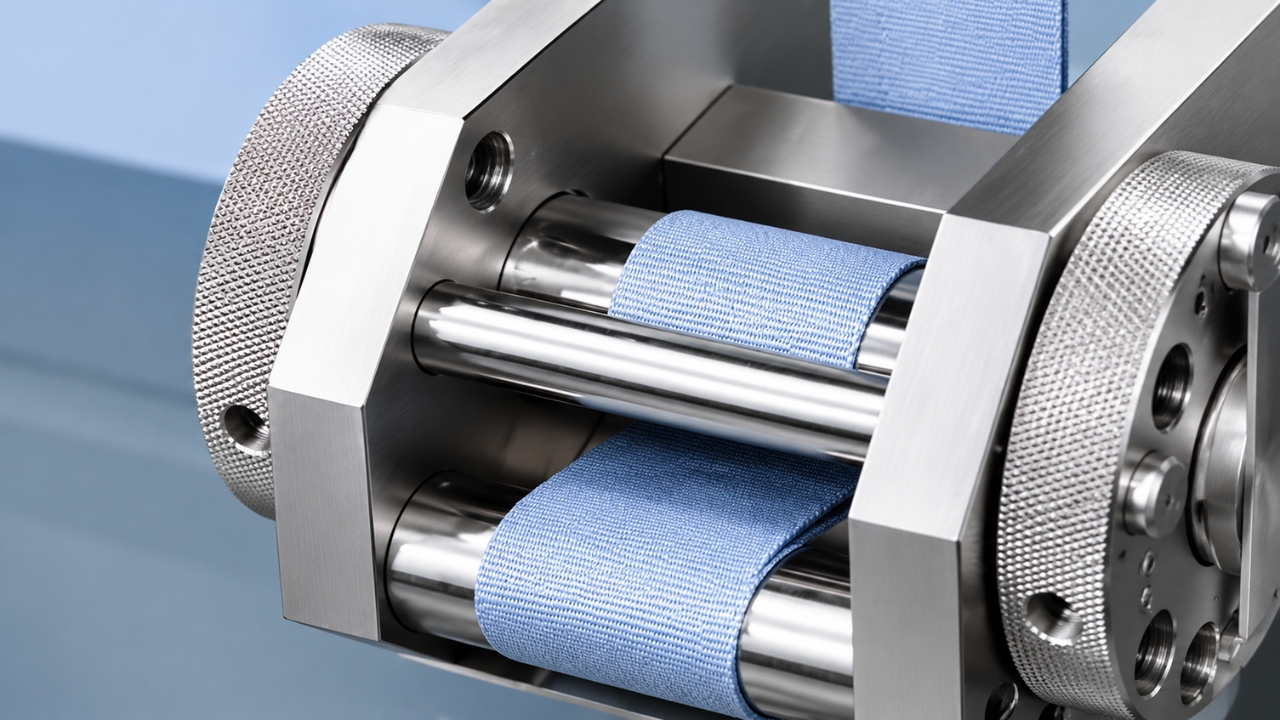 Racing Harness Inspection and Maintenance
Webbing Inspection
Routine inspections of webbing do not require specialized testing equipment, and many surface problems can be identified with the naked eye. Check for cuts, areas of fraying or wear, as well as signs of hardening, deformation, or noticeable discoloration.
You can include these inspection points in your after-sales documentation for end customers to refer to. Once obvious damage is detected, discontinue use rather than waiting for the damage to worsen before taking action.
Buckle Inspection
Dust and moisture are common environmental factors in off-road and track environments. The way the buckle operates may also change after long-term use.
If there is only dust on the surface, it can be cleaned according to the product instructions. After cleaning, operate the buckle several times to check whether it locks and releases properly and whether the adjuster moves smoothly. If the buckle becomes deformed, fails to lock securely, or gets stuck, discontinue use and handle the issue in accordance with the manufacturer’s instructions and applicable event regulations.
Pay Attention to Storage Conditions
When cleaning seat belts, do not use highly corrosive cleaning agents, as they may damage the webbing or hardware.
Many racing cars and UTVs are parked outdoors for extended periods, and exposure to ultraviolet rays, high temperatures, and moisture can affect seat belt components. Over time, the webbing may gradually deteriorate, and the metal fittings may also corrode. You can include simple cleaning and storage tips in your after-sales instructions, allowing customers to perform routine maintenance according to actual storage conditions.
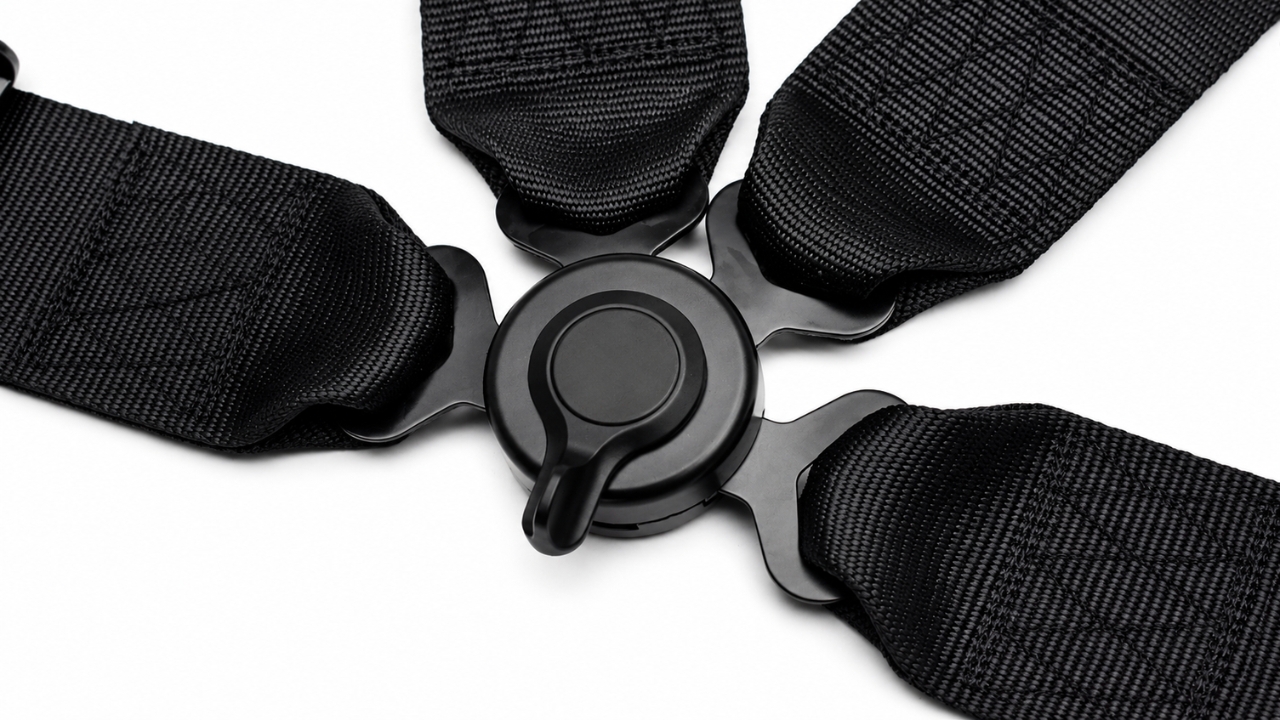 After a Severe Impact
Even if a seat belt appears intact after a severe impact, its appearance alone cannot confirm that it is still safe to use. A strong impact may cause internal damage that is invisible to the naked eye, affecting its original protective performance.
Seat belts should not be used if they have been subjected to a severe impact or extreme stress. As a distributor, do not take back these products and resell them. Subsequent handling should comply with the manufacturer’s instructions and applicable event regulations.
When to Replace a Seat Belt
It is difficult to set a uniform replacement period for seat belts that applies to all usage scenarios. Actual wear and tear is affected by factors such as frequency of use, storage conditions, and the degree of stress, and may vary greatly between different vehicles and usage environments.
You can remind end users in your after-sales documentation to make a comprehensive assessment based on the actual condition of the webbing and buckles, as well as the manufacturer’s specifications and applicable competition standards. Do not decide whether to replace a seat belt based solely on its usage time.
Yes. You can order different styles in the same order, such as 4-point and 5-point multi-point seat belts. Just communicate and confirm the quantity and production schedule details in advance. If we supply multiple types of customers, we can have much more flexibility in stocking, and we don’t need to order each style separately.
Not all models are ECE R16 / E-mark certified; the specific certification scope depends on the model itself. When submitting an inquiry, please specify your destination market, vehicle application, and required compliance documents. We will check the specific model first to avoid discovering that the certification does not meet local requirements after the goods are ready.
Yes. When encountering new car models or customized projects, we recommend taking a sample first. You can check the mounting points, hole positions, webbing length, and buckle matching to confirm whether it is compatible with the vehicle body structure. If the size or configuration needs to be adjusted, it can be determined before mass production, and subsequent large-scale products will be produced according to the confirmed plan.
It is not recommended to directly replace the original seat belts of ordinary passenger cars with multi-point racing seat belts for road driving. These products are mainly used for racing, off-road modification, and special vehicles with supporting fixed structures. Before installation, it is necessary to confirm whether there are suitable installation points on the vehicle body.
If you supply modification shops, dealers, or automotive brands, it is recommended to specify the applicable scenarios on the product page and packaging. Whether or not a vehicle can be put on the road ultimately depends on local regulations, product certification, and the structure of the vehicle itself.