


Incompliant commercial seat belt safety products will cause safety hazards, certification audit failures, and increased after-sales maintenance costs. This article delivers regulatory requirements, types of seat belt systems, and key metrics to evaluate safety performance, helping you choose a reliable seat belt provider and save on long-term operation costs.
Why Does Commercial Seat Belt Safety Compliance Matter for Your Business?
A seat belt is a woven fabric strip that bears all the restraining loads during a collision. In terms of preventing casualties in motor vehicle collisions, seat belts are the most effective safety device.

Compliant with Legal Norms
The seat belt must comply with government regulations to ensure adequate safety. A legally certified seat belt system can help you avoid legal disputes and fines.
The latest safety belt regulations have introduced new measures for the use of safety belts:
- New vehicles must be equipped with a rear passenger safety belt reminder system that complies with ECE R107 or FMVSS No.208.
- More stringent regulations for child car safety seats have been implemented. Children with a height of less than 135 cm or an age of less than 12 years must use child restraint systems compliant with ECE R129 (i-Size) standard, which requires ISOFIX anchorages.
- Commercial vehicles must use safety belts that comply with FMVSS No.209 or equivalent standards, with seat belt anchorages meeting FMVSS No.210 requirements, and all vehicle safety belt inspections and usage must be recorded.
Reduces the Risk of Serious Injuries
When a vehicle collides, due to inertia, the human body continues to move. Seat belts can limit the movement of the body and distribute the impact force to the strongest parts of the body, such as the chest, shoulders, and pelvis, thereby absorbing the impact and significantly reducing the possibility of serious injury.
Commercial vehicles equipped with compliant safety belts can reduce the incidence of accidents, thereby lowering your compensation costs for work-related injuries and preventing disruptions to the fleet’s operational capacity.
Protecting Occupants Across Every Seat Position
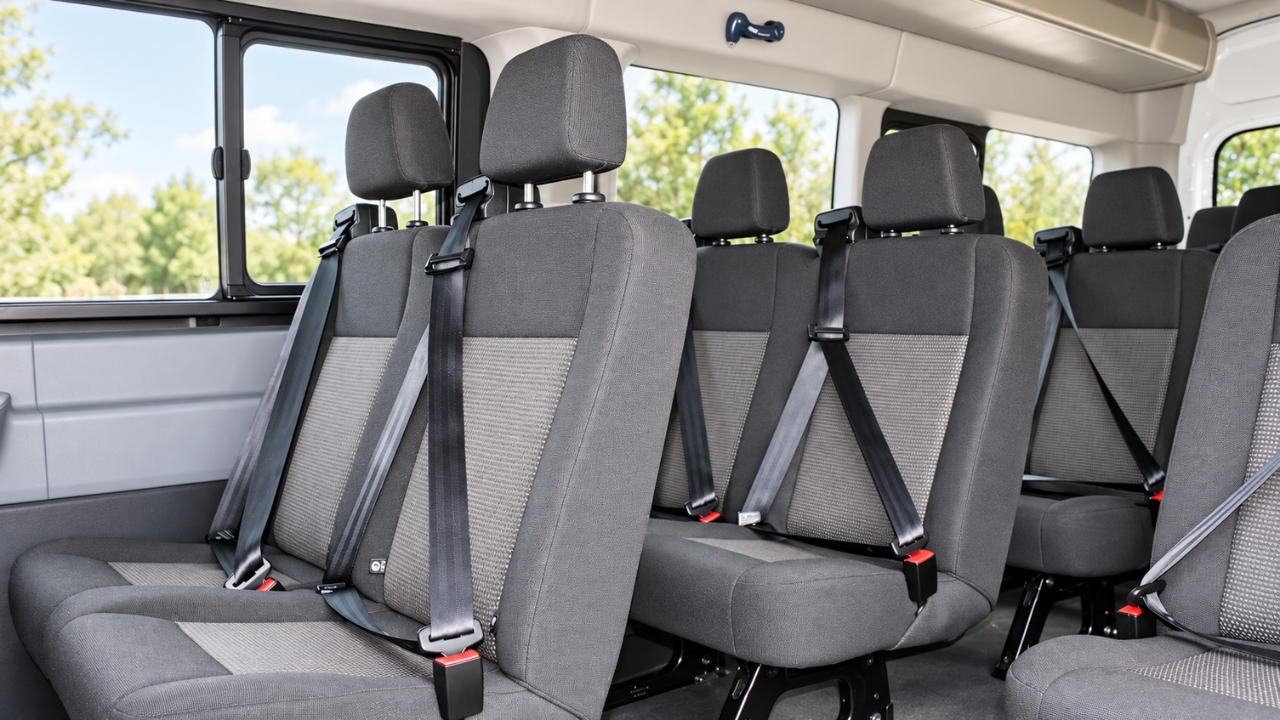
If there are no seat belts, in a collision, passengers in the rear seats may be thrown forward, which will increase the danger for both them and the front passengers. Fastening the seat belt can prevent collisions between passengers, between passengers and objects inside the vehicle, and prevent or reduce injuries caused by secondary collisions. Moreover, substandard rear industrial seat belt safety systems will lead to regulatory non-compliance and failed official certification audits for your vehicles.
Preventing Occupants from Being Thrown Out
If there is a violent collision or a vehicle rollover, seat belts can maximize the safety of the driver and passengers, preventing them from being thrown out of the vehicle and keeping them inside the protective shell of the car, which can increase the survival rate and reduce injuries.
Types of Industrial Seat Belt Safety Systems for Different Commercial Applications
Vehicles in different applications require different load-bearing capabilities, collision resistance, and durability. Therefore, they need to be equipped with different types of seat belts. We will introduce the main types of seat belts and their applications for you. You can choose the most suitable seat belt according to your needs.
Two-Point/Hip belt
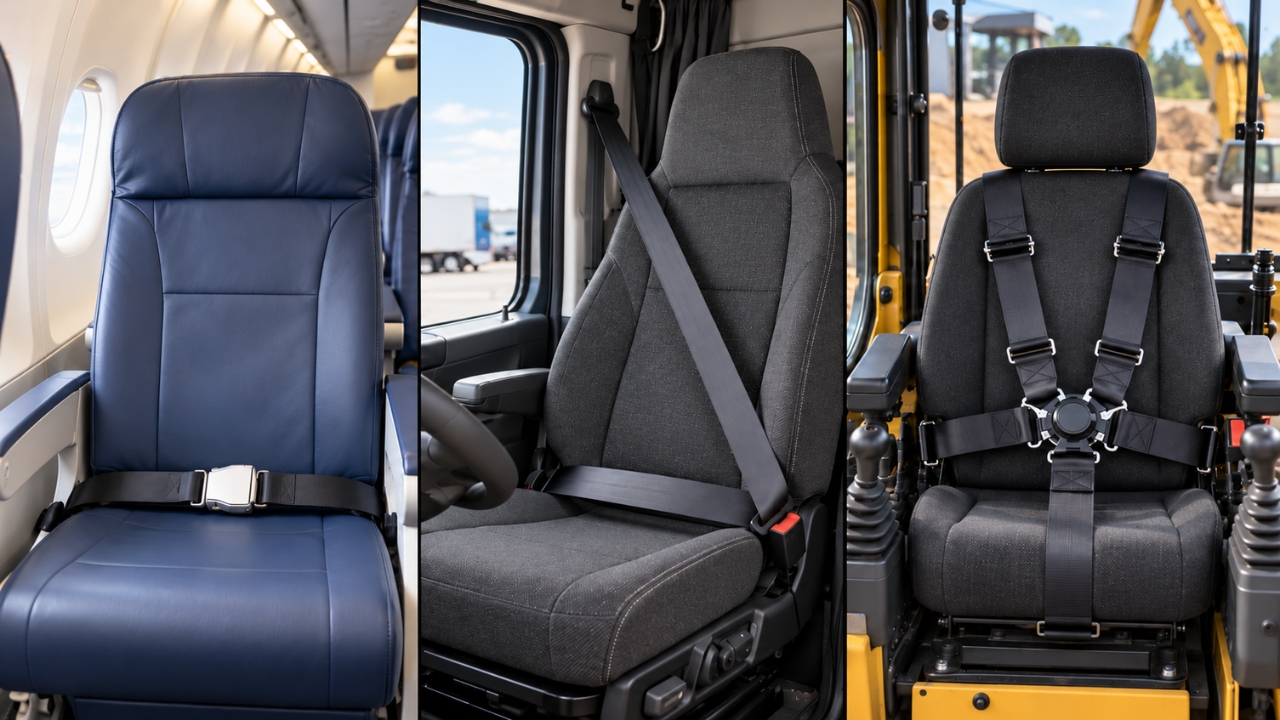
The design of the two-point safety belt is to distribute the impact force to the pelvis rather than the abdomen. Therefore, it should be firmly fastened at the hips and extend up to the upper part of the thighs, rather than adhering to the abdomen.
This two-point safety belt is commonly found in the middle seats of vehicles, the front seats of old-fashioned vehicles, school buses, and airplanes.
Three-Point/Shoulder Belt
The three-point safety belt is the most commonly used type in modern vehicles. Just like the design of the two-point safety belt, it is also intended to distribute the impact force, but it is safer because it spans the shoulders and the waist and can distribute the impact force over a larger area.
Five-Point Safety Belt
The five-point safety belt consists of two shoulder straps, two lap straps, and one crotch strap between the legs. Due to its better protective performance, it is widely used in child car seats, construction machinery, and off-highway industrial vehicles.
Key Metrics to Evaluate Seat Belt Safety Performance
The safety performance of seat belt safety systems can be evaluated by five core indicators: tensile strength, elongation rate, wear resistance, UV resistance and chemical corrosion resistance, as well as the retention rate of width/thickness under load. These key metrics determine whether your products meet FMVSS No.209 and ECE R16 certification requirements, whether they will fail prematurely, and whether they will endanger the lives of passengers.
Tensile Strength
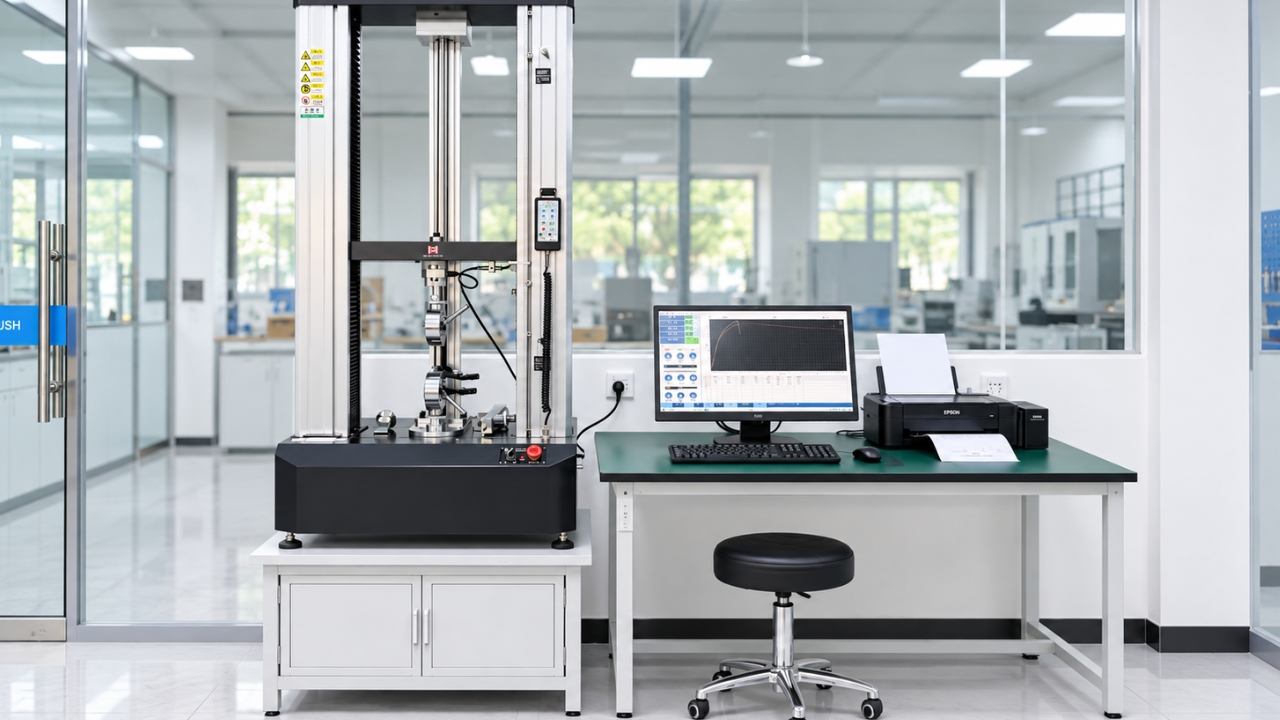
Tensile strength is the most fundamental indicator of seat belt safety performance. A universal tensile testing machine measures the maximum force the webbing can withstand before breaking, helping ensure it does not easily lose performance or condition over time.
- The FMVSS No.209 standard stipulates that the breaking strength of the two-point seat belt assembly must be ≥ 22,250 N.
- The ECE R16 standard stipulates that the minimum tensile strength is 14,700 N for shoulder webbing and 22,250 N for lap webbing, and the minimum breaking strength of the entire seat belt assembly must be ≥ 22,250N.
Elongation Rate
Elongation rate is a measure of the degree of stretching of the seat belt webbing under a specific load. The optimal elongation rate for seat belts should be controlled within 15-20%. An excessively low elongation rate would exceed the impact force that the occupant’s chest can withstand; an excessively high elongation rate would increase the risk of collision between the occupant and internal vehicle components such as the steering wheel and dashboard.
- FMVSS No.209 standard stipulates that under a load force of 11,120 Newtons, the elongation rate of the seat belt should be ≤ 20%.
- ECE R16 standard stipulates that under a load of 9810 N, the elongation rate of the seat belt must be ≤ 20%.
Wear Resistance
Wear resistance refers to the ability of the seat belt webbing to maintain its structural integrity and appearance under repeated mechanical wear during long-term use.
- FMVSS No.209 standard stipulates that the webbing must meet the minimum tensile strength requirement after being subjected to 2,500 cycles of friction on a steel rod with a radius of 3.2 mm under the specified load. This indicates that it has structural integrity.
However, you should be aware that if you visually inspect and find visual wear such as fuzzing or discoloration does not always mean tensile strength has fallen below minimum requirements; for commercial fleets, formal tensile testing is required before deciding to continue using worn belts to ensure compliance and liability protection.
UV Resistance & Chemical Corrosion Resistance
The ultraviolet resistance and chemical corrosion resistance directly affect the service life of the seat belt and your long-term maintenance costs. Seat belts that are exposed to ultraviolet radiation for a long time or affected by chemical pollutants will experience earlier failure in their mechanical properties and color fastness, resulting in a shorter service life.
Ultraviolet Resistance
You can conduct accelerated UV aging testing for webbing mechanical performance per SAE J1885 (automotive interior material standard), and test color fastness per ISO 105-B02. By subjecting it to 300-500 hours of ultraviolet aging treatment and temperature cycling from -40°C to +80°C, you can test its tensile strength and color change of the webbing.
After 300 hours of xenon arc exposure, high-tenacity polyester webbing retains approximately 80%–90% of its original tensile strength, while nylon webbing may drop to 60%–70%.
Chemical Corrosion Resistance
You can assess the chemical resistance of seat belt webbing per SAE J1886 (automotive webbing chemical resistance test method) using sweat, cleaning agents, fuel, and hydraulic oil. A corrosion-resistant seat belt will not have dye leakage, will not cause staining to adjacent materials, and its strength will not significantly decrease.
Dimensional Stability
Dimensional stability refers to the ability of the seat belt webbing to maintain consistent width and thickness in both a static state and under tension load.
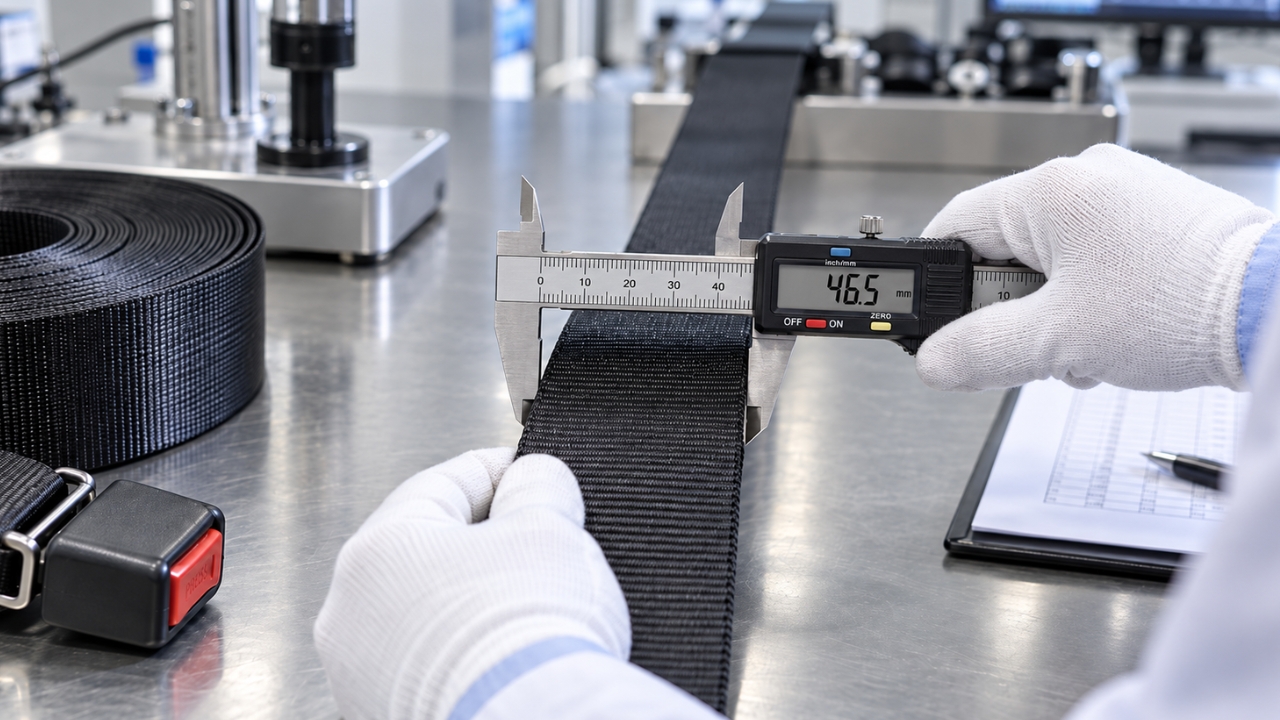
The width of a standard seat belt is usually around 48 ± 1.5 mm, and its thickness ranges from 1.1 mm–1.4 mm. After stretching or undergoing thermal aging treatment of the seat belt, if the width or thickness changes by more than 2%, it may cause the woven belt in the retractor to be wound irregularly, resulting in clogging or unsmooth retraction, thereby increasing your after-sales maintenance costs.
How to Select a Reliable OEM Seat Belt Manufacturer?
A professional seat belt service provider can manage compliance risks for you, support product customization, and have a long-term and stable supply chain. When you are choosing a suitable seat belt service provider, you should not only focus on the price of the seat belts. The following are the evaluation criteria you should follow when selecting a service provider:
Qualification Certification
A professional seat belt service provider should meet the requirements of national automotive safety product certification, ISO quality system certification, and other related certifications.
For the seat belts produced by the service provider, you should require the provider to provide a formal type approval certificate issued by the certification body, such as FMVSS No.209 certification or ECE R16 certification.
Batch Quality Consistency & Traceability
A reliable manufacturer maintains consistent quality across mass production, not just lab samples. You should verify their incoming inspection protocols for raw materials, in-process testing standards, and finished product defect rate (the industry benchmark for premium factories is ≤ 0.1%). Most importantly, confirm they provide full batch traceability: each production batch should be linked to raw material sources, production records, and test reports, which is essential for regulatory audits and targeted recalls if needed.
Technical Support & After-sales Service System
A reliable supplier will provide complete technical documents, installation manuals, formal compliance statements, and after-sales guarantee systems to assist you in internal audits and customer acceptance work.
High-quality seat belts usually have a 2-3 year product warranty period, and reliable suppliers offer ongoing technical support and compliance consulting throughout the cooperation period.
OEM Customization Capability
High-quality seat belt service providers not only have rich production experience but also can provide customized services, such as surface customization like logo marking, structural customization for special vehicle types, and functional adjustments to retractor sensitivity.
FAQ
When Should Commercial Vehicle Seat Belts Be Replaced?
If any of the following situations occur with your commercial vehicle’s seat belts, we recommend that you replace them:
- Conduct a formal inspection and condition assessment once the vehicle exceeds 5 years of service, and replace seat belts based on wear and aging.
- If the seat belts or their components are worn, torn, cracked, or damaged.
- If the seat belts cannot retract normally or the buckles are damaged.
- If your commercial vehicle has been involved in an accident, even if there is no visible exterior damage, it is best to inspect and replace the seat belt components.
What Is the Core Difference Between FMVSS No.209 and ECE R16 Seat Belt Safety Standards?
FMVSS No.209 and ECE R16 seat belt safety standards differ in terms of release force, durability cycles, corrosion resistance, and child restraint interfaces:
| Parameter | FMVSS No.209 | ECE R16 |
| Release Force | ≤ 60 N maximum requirement | ≤70 N maximum force required to unlatch (post-sled test) |
| Durability Cycles | 5,000 cycles (webbing + buckle), no load | 10,000 cycles under 100 N load; additional 5,000 cycles with 25 N load for ALR modes |
| Corrosion Resistance | 24-hour salt spray (ASTM B117), no red rust on load-bearing parts | 72-hour neutral salt spray (ISO 9227), plus evaluation of electrical continuity for smart buckles |
Does On-Site Retrofitting Affect a Seat Belt’s Original Safety Compliance Certification?
Yes, on-site modifications usually result in the loss of the seat belt’s original safety compliance certification. The certification issued by the factory is only valid for seat belts that are installed in accordance with vehicle specifications and at the designated installation positions. Any uncertified modifications will expose you to penalties from regulatory authorities. If you insist on making the changes, then you must conduct a new certification test.
How Do Extreme High and Low Temperatures Impact Industrial Seat Belt Safety Performance?
Long-term extreme temperature cycling degrades webbing mechanical performance, causing toughness reduction and accelerated aging.
- Under sustained extreme heat above 95 °C, often seen in enclosed vehicles under direct sunlight, combined with UV exposure, polyester webbing polymers undergo aging and molecular degradation, resulting in gradual tensile strength loss and reduced impact-absorption performance.
- When the temperature drops below -30°C, the webbing material becomes stiffer and more brittle, with reduced impact toughness and elongation at break, while its static tensile strength actually increases. Meanwhile, lubricant inside the retractor thickens, resulting in slower lock response and degraded retraction reliability.
What Are the Most Common Causes of Seat Belt Safety Failure?
The main reasons for the failure of seat belts include:
Wear and Tear: Long-term use leads to deterioration of the fabric material and wear on the belt components.
Manufacturing Defects: Defects in the buckle, improper stitching, or substandard materials affect the performance of the seat belt.
Fragment Accumulation: Debris such as dirt, dust, or food residues accumulate in the belt retractor, jamming the pawl and ratchet components inside the retractor housing.
Improper Use: Incorrect insertion of the tongue into the buckle leads to failed latching, rather than retractor damage.
Extreme Temperature Exposure: Prolonged exposure to extreme temperatures will weaken the corrosion resistance of the webbing, causing it to become brittle and crack.
Regular inspection and timely replacement of components are the most economical and effective preventive measures to avoid unexpected failures of seat belts.
Final Thoughts
Selecting the right commercial seat belt safety system depends on service provider qualification, the performance parameters of the seat belt, and applications. Contact us if you are sourcing custom industrial seat belt services. Bxseatbelts can provide you with a one-stop service from production to maintenance.