


Irregularly cleaned seat belts will age and wear out, reducing their safety performance. This leads to failure in safety compliance checks and incurs high replacement costs. This article provides you with a detailed professional cleaning solution for commercial seat belt cleaning, helping you reduce long-term operational and maintenance costs.
Why Does Proper Seat Belt Cleaning Matter?
Seat belts are one of the core components of the automotive safety system and are crucial for ensuring the safety of the driver, as they help minimize the injuries caused by impacts during accidents by reducing the force on the body.
Ensure Compliance
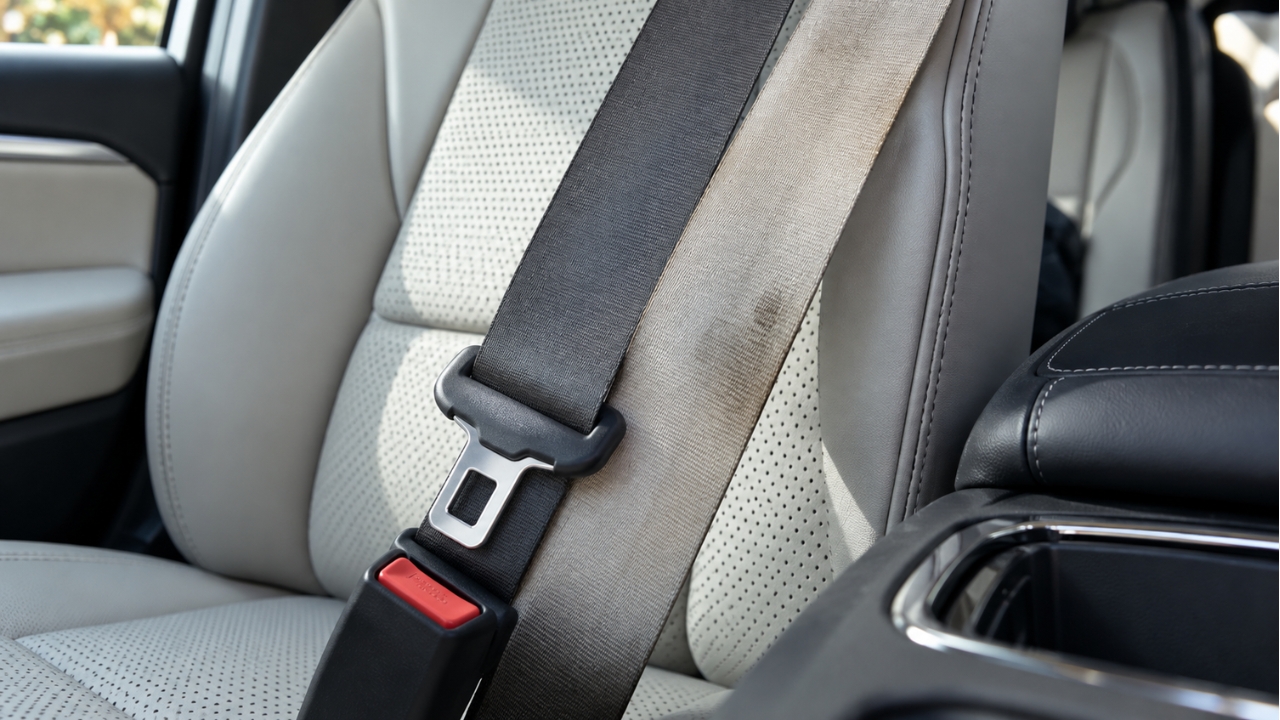
Accumulated cabin dust, industrial contaminants, passenger residues, and persistent humidity cause seat belt soiling, yellowing, and mold growth over time. If not cleaned in time, these long-standing stains will breed mold, reducing the safety performance of the seat belt, causing it to age and become brittle, resulting in the failure of your seat belt inspection and compliance risks.
Save Operating Costs
Once the seat belt ages, its internal structural strength will significantly decrease, making it prone to damage. You will need to replace the seat belt frequently. This will increase your procurement costs and installation costs. Standard commercial seat belt cleaning procedures effectively extend their service life and save operating costs.
Maintain Corporate Image
Substandard seat belts lead to a decline in their safety performance, which will reduce customers’ trust in you, damage your corporate image, and long-term business cooperation for commercial vehicle enterprises.
Next, we will provide you with a detailed guide for cleaning your seat belts, including the preparatory steps, the actual cleaning process, and the daily maintenance measures.
 Pre-Cleaning Preparation & Safety Guidelines
Before officially starting the cleaning process, you need to take the necessary preparatory measures to save your cleaning time:
Function Check
You need to first check the seat belts. If any of the following situations are found, we recommend that you replace them immediately or conduct a more professional inspection.
- Worn seat belts
- Damaged or torn seams
- Damaged stitching
- The belt cannot be fastened properly
- The belt cannot be locked properly
- Damage caused by the collision
- Other abnormal situations related to the normal function of the belt
Apart from the aforementioned issues, the following problems can be effectively resolved after cleaning the seat belt:
- Visible stains
- A musty or sour smell when pulling the belt
- A sticky or greasy feel on the fabric surface
- A belt that cannot smoothly return to its original shape
Tools & Supplies
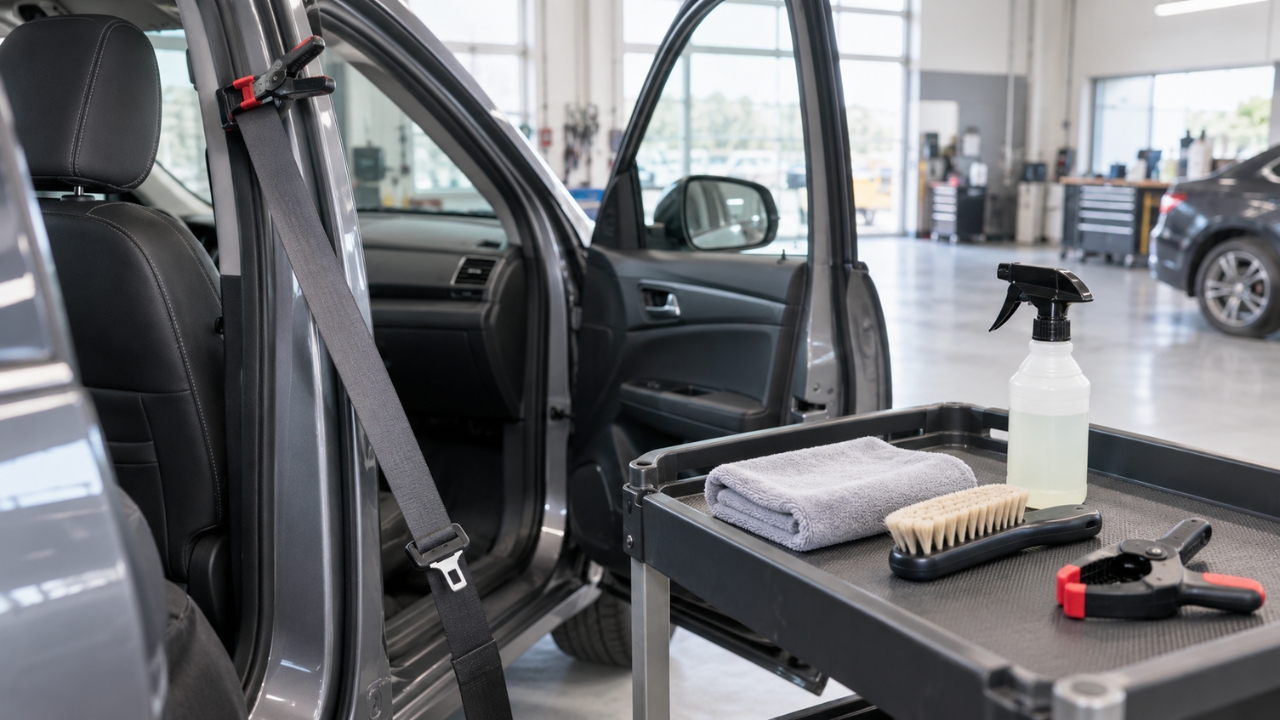
Prepare all the cleaning tools listed below at once, which can save your cleaning time and prevent damage to the seat belt.
- Clean purified water
- Soft-bristled brush – safe for fabric
- Mild cleaner
- Clean microfiber towels –prevent snags
- A clamp or clip for holding the seat belt in place
Environment
You’d better open all the vehicle doors or windows to ensure a well-ventilated maintenance workspace. This will help disperse the smell of the cleaning agent and speed up the drying process.
 Step-by-Step Professional Seat Belt Cleaning Process
Following proper preparation, you can carry out the full cleaning workflow by following the steps below.
Step 1: Pull Out and Secure the Seatbelt
Fully pull out the seat belt, keep it extended, and use a clean clip or spring clip to secure it near the retractor to prevent the belt from retracting into the retractor. This will make it easier for you to thoroughly clean it. You don’t need to remove the seat belt unless professional deep steam extraction is required for heavy-contamination fleet assets.
Step 2: Vacuum First
Use a handheld vacuum cleaner or an indoor gap suction nozzle to remove any remaining objects such as hair, debris, dust, and granular residue to avoid secondary webbing friction damage during cleaning.
Step 3: Pre-Treat Stains
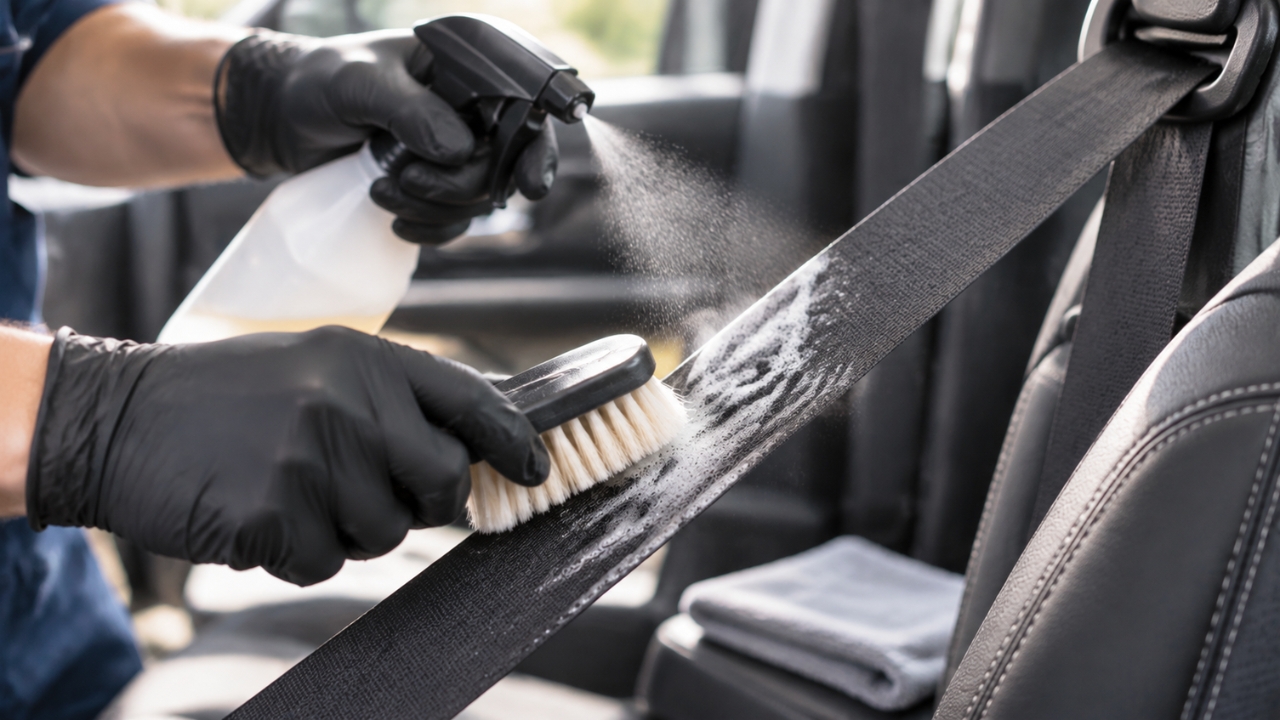
After spraying the diluted multi-purpose cleaner or targeted stain remover gently and evenly onto the seat belt surface, let it sit for about 30–60 seconds to dissolve the stains.
Please do not use bleach, alcohol, acetone, gasoline, or chemical thinners. These corrosive substances damage the polyester webbing fiber structure, weaken tensile strength, causing premature seat belt failure. Furthermore, do not soak the webbing or spray cleaning agents directly into the retractor assembly. Otherwise, it may lead to mold growth or retractor malfunction.
Step 4: Agitate Gently
Use a soft or medium-hard interior cleaning brush to scrub up and down to remove dirt and oil stains. Do not scrub forcefully or use a hard-bristled brush, as this will damage the webbing fibers and compromise the original flame-retardant and wear-resistant properties of commercial-grade seat belts.
 Step 5: Wipe Clean
Use a clean, slightly damp microfiber towel to repeatedly wipe the seat belt until it is clean. This will remove loose dirt and excess cleaning agents and prevent snagging. You should avoid using overly wet towels. Excess moisture leaves residue inside the retractor, encouraging mold growth, fiber hardening, and retractor malfunction. Therefore, be sure to wring out the towel completely.
If the stain on the seat belt is quite severe, you can use steam or an air extractor, but be sure to set the temperature at a lower level; otherwise, high heat will degrade the belt’s inherent flame-resistant and wear properties.
Step 6: Dry Properly
After wiping off all residual cleaner, fully extend and secure the belt with a clip, then allow it to air-dry completely in ambient conditions. As a result, the belt won’t develop mold or have a musty smell. Once fully dry, release the clip and allow the belt to retract back into the retractor. Otherwise, the retractor will get damp, causing mold and premature wear inside the retractor assembly. Additionally, for fleet seat belt deep cleaning, you must ensure that the seat belt is protected from direct sunlight, kept away from heaters, and not used with heat guns or blow dryers, as these methods of accelerating the drying process will compromise the integrity of the seat belt.
Step 7: Check Retraction and Buckle Operation
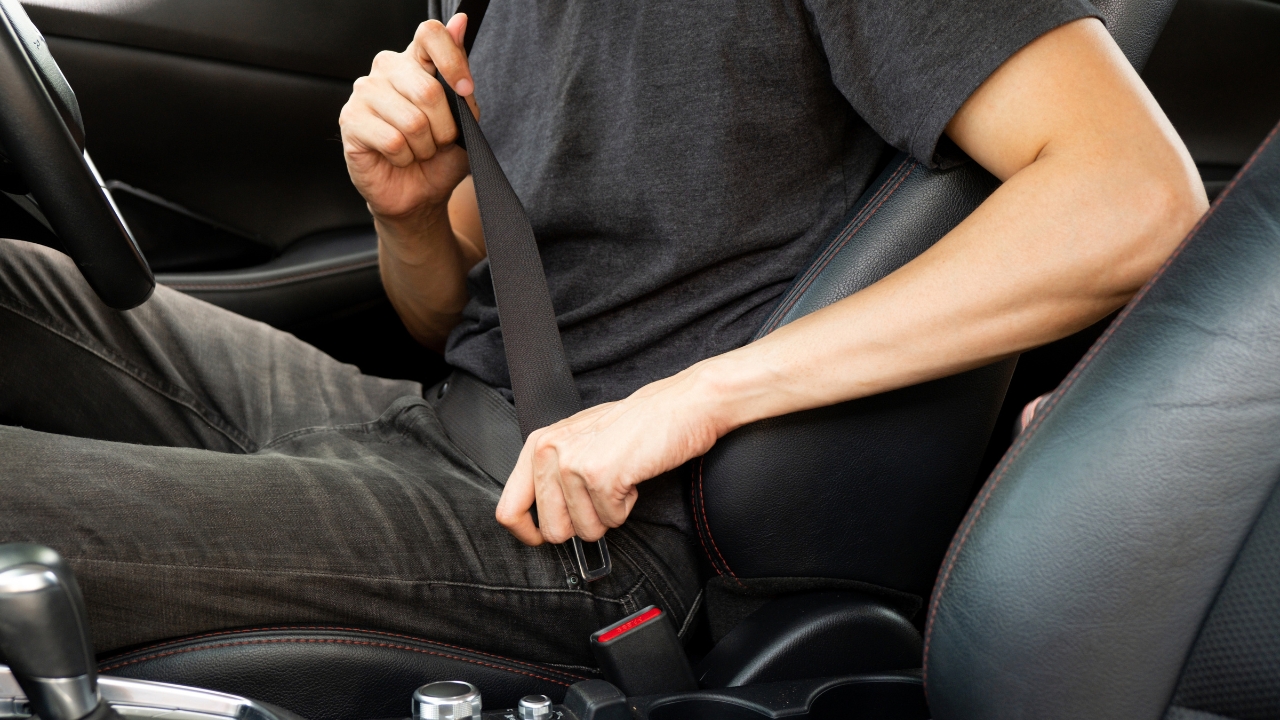
After the seat belt has dried, you can allow it to retract naturally and check if it operates smoothly. Then you can re-tighten and loosen the belt buckle to confirm that it is functioning properly. A properly cleaned seat belt should be able to extend smoothly without any abnormal resistance, and it should not repeatedly get stuck when retracting.
 Tips for Long-Term Fleet Seatbelt Maintenance
A one-time deep cleaning can only address surface dirt issues. However, the following standardized regular maintenance measures can help you extend the service life of the seat belts. If you operate commercial vehicles, regular maintenance of the seat belts can reduce your long-term operation costs.
Establish a Fixed Seatbelt Maintenance Schedule
High‑utilization commercial fleets and industrial vehicles require quarterly inspection and cleaning of seat belt assemblies.
Maintain a Clean Cabin and Operating Environment
As the manager of a fleet of commercial vehicles, you need to ensure that the working environment of all operating vehicles remains dry and clean, avoiding long-term exposure to damp or severely contaminated environments, as this will shorten the service life of the seat belts and cause corrosion.
Check Seat Belt System Performance
During regular vehicle maintenance, you should focus on checking the degree of seat belt wear and the sensitivity of the buckles, and record the service status of each batch of seat belts, so as to achieve standardized overall management and ensure that the seat belts meet safety standards.
 FAQ
Can I Machine Wash Seat Belts?
No, seat belts cannot be machine washed. They can only be hand-washed because mechanical stirring and high-alkali laundry detergents damage the fiber structure and flame-retardant coating of the seat belts. Moreover, you can only gently wipe the seat belts up and down with a mild, diluted cleaner, and you must not draw circles when scrubbing, as this would distort the woven webbing structure.
Why Won’t My Seat Belt Retract After Cleaning?
There is residual moisture inside the retractor; the seat belt has not been completely dried, and there are still cleaning agents that have not been thoroughly wiped off on the surface of the seat belt. All these factors will cause water and chemical residue to build up inside the retractor, resulting in friction when the seat belt retracts and hindering its normal retraction.
In addition, if you stretch the seat belt excessively during the cleaning process, causing the internal recovery track to become misaligned, the seat belt will also be unable to retract normally.
Can Stained Seat Belts Be Restored to Look Like New?
Yes, many stains can be completely removed with the right cleaning agent and method. For stubborn stains, multiple washes may be necessary. However, if the stains have caused the seat belt to wear out or become brittle, for the sake of driving safety, it is recommended that you replace the seat belt with a new one directly.
What Safety Standards Should Fleet Seat Belt Cleaning Comply With?
The cleaning work of seat belts should comply with the FMVSS No.209 standard and the FMVSS No.302 standard.
- FMVSS No.209 Standard: It stipulates the performance and strength requirements for seat belt components and also requires that the maintenance methods must not reduce the quality and performance of the seat belt.
- FMVSS No.302 Standard: It stipulates that no cleaning agents that can damage or degrade the flame-retardant coating on the surface of the seat belt can be used.
- ECE R16 Standard(European market): This regulation sets mandatory performance, strength, and testing requirements for seat belt assemblies, and requires that any maintenance practice must not degrade the original component performance or structural integrity.
Can Sanitizing Seat Belts Affect Webbing Friction and Safety Performance?
Unless you have obtained specific permission or use mild and residue-free disinfectants, do not use any overly potent or unstandardized disinfectants to clean the seat belt. These may damage the friction properties of the fabric and reduce the safety protection effect.
Final Thoughts
Adopting commercial seat belt cleaning and maintenance methods can ensure their functional stability, making them compliant with safety inspection standards and reducing your long-term operation and maintenance costs. Contact us if you are sourcing seat belt services. Bxseatbelts can provide you with a one-stop service from production to maintenance.