
Custom 6-Point Harness
BX 6-Point Harnesses Are Designed For Circuit Racing Cars And Track-Prepared Vehicles, Providing Reliable Driver Restraint With Applicable Configurations Designed And Tested According To FIA 8853-2016 Requirements.
• Application: Circuit Racing & Track Vehicles
• Function: Reliable Driver Restraint
• Standard: FIA 8853-2016 Tested
6-Point Harnesses Manufacturer in China
BX’s 6-point safety harnesses are high-strength restraint systems designed for motorsports. Our 6-point safety harnesses use two shoulder straps, two pelvic straps, and two crotch straps to restrain the driver. Compared to standard safety belts, these 6-point safety harnesses are more suitable for motorsports applications.
BX has over 20 years of experience in safety harness manufacturing and specializes in the R&D and production of automotive and motorsports safety harnesses. From webbing and buckle production to final assembly, all key processes are completed in our own factory. We also have a 500+ m² testing laboratory where we can conduct webbing strength, fatigue, and hardware-related tests for your projects. We also support OEM/ODM customization for six-point seat belts, and we can adjust the configuration and appearance of the seat belts according to your brand positioning. If you’d like to learn more about customization options for six-point seat belts, please feel free to contact us at any time.
Types of Our 6-Point Harnesses
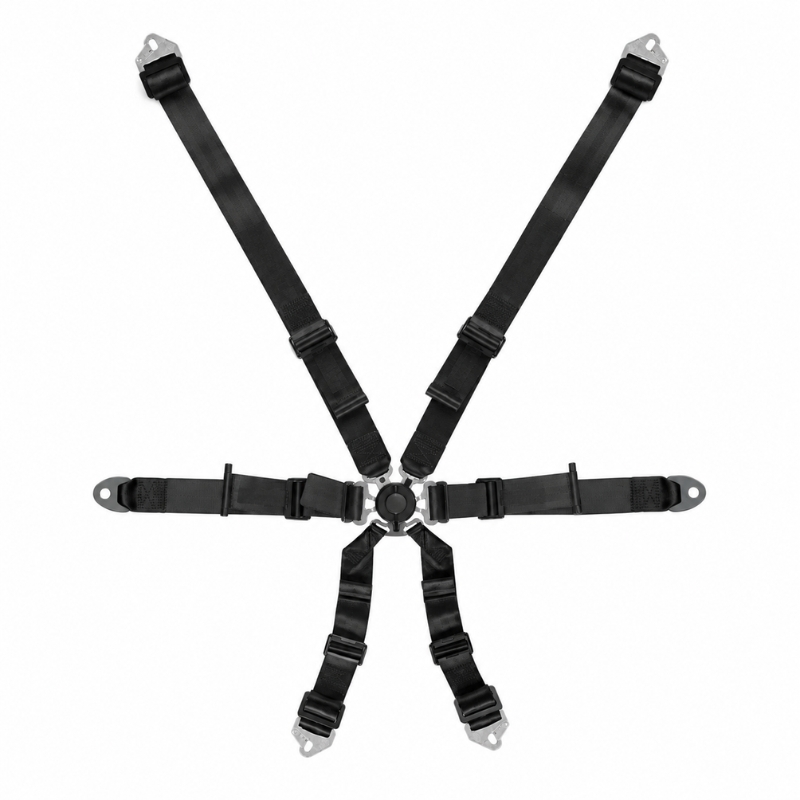
Features 2-inch shoulder straps for HANS/FHR-compatible configurations, with a compact and lightweight restraint setup.
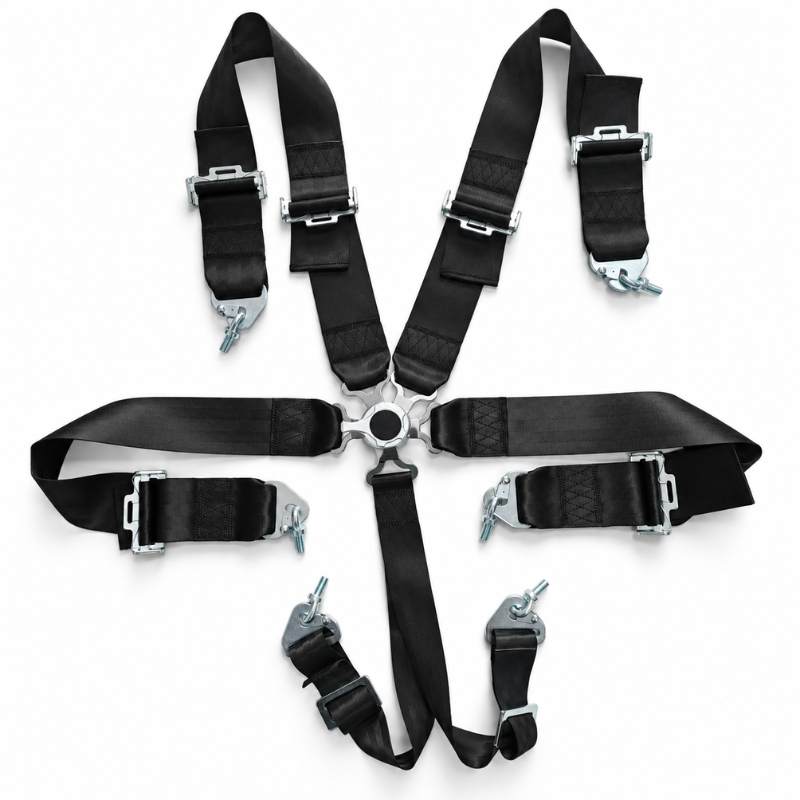
Features wider 3-inch shoulder straps for a larger contact area and broader load distribution.
Features of Our 6-Point Harnesses
- Uses dual anti-submarine straps for pelvic restraint.
- Heavy-duty 2″/3″ polyester webbing for secure restraint.
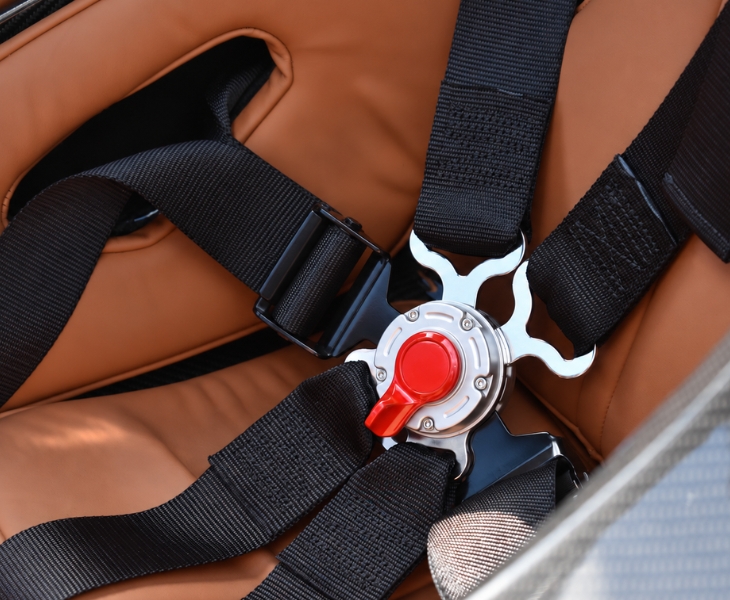
- Features a magnesium alloy cam buckle for quick release.
- Uses aluminum shoulder adjusters for easy adjustment.
- Supports HANS and FHR-compatible shoulder strap configurations.
- Supports both wrap-around and bolt-in mounting.
- Supports custom colors, logos, and hardware.
6-Point Harnesses Specification
| Item | Specification |
| Product Type | Racing Harnesses |
| Product Line | BX 6-Point Racing Harnesses |
| Latch Style | Camlock |
| Attachment Configuration | 6-point |
| Harness Type | Complete harness |
| Shoulder Belt Mounting Style | Clip-in / Bolt-in |
| Shoulder Belt Mounting Location | Clip-in / Bolt-in, depending on vehicle anchorage configuration |
| Lap Belt Mounting Style | Wrap-Around / Bolt-In |
| Anti-Submarine Belt Mounting Style | Wrap-Around / Bolt-In |
| Belt Color | Black, red, custom Pantone color available |
| Shoulder Harness Type | Individual shoulders |
| Shoulder Belt Width (in.) | 2.00 in. / 3.00 in. Optional |
| Lap Belt Width (in.) | 2.00 in. |
| Submarine Belt Width (in.) | 2.00 in. |
| Belt Adjustment | Pull down |
What Is a 6-Point Harness?
The six-point harness is a professional multi-point restraint system designed for motorsports. The complete safety system includes two shoulder straps, two pelvic straps, and two crotch straps that secure the driver’s shoulders, hips, and pelvis. The six restraint points work together to secure the driver’s body, minimizing body movement during high-speed braking or sharp turns. If you are sourcing seat belts for your brand, a six-point seat belt system can meet your application needs. You can choose the suitable product configuration based on the vehicle and installation location.
How Does a 6-Point Racing Harness Keep the Driver Secure?
Six-Point Restraint Structure
A six-point harness secures the driver’s body at various points. The two shoulder straps are used to restrain the upper body and prevent it from moving forward. The two lap straps secure the hips, helping the test driver maintain the correct position in the seat. The two anti-submarine straps restrain the pelvis from below and work in conjunction with the lap straps to prevent the body from sliding downward.
Secure Webbing, Stitching, and Hardware
A safety harness’s restraint performance depends not only on its structure but also on the quality of the connections between the webbing, stitching, and hardware. Our six-point safety harness uses high-strength industrial polyester webbing, and the monofilament weaving process enhances both the webbing’s strength and the quality of the edge finishing. All hardware components are made of forged steel and have undergone a black oxide treatment.
Stable Mounting and Driver Adjustment
The installation method and adjustment mechanism must be compatible with the racing seat and the vehicle’s mounting points. The BX’s six-point harness supports both wrap-around and bolt-on installations. The harness can be mounted to the chassis or roll cage, with the mounting points selected according to the vehicle and harness configuration. Our pull-down adjuster is positioned close to the cam lock for easier adjustment. You can also choose the mounting and adjustment configurations based on your vehicle structure.
6-Point vs. 5-Point vs. 4-Point Harness: What Is the Difference?
| Feature | 4-Point Harness | 5-Point Harness | 6-Point Harness |
| Shoulder straps | 2 | 2 | 2 |
| Lap belts | 2 | 2 | 2 |
| Crotch Strap Configuration | None | Single crotch strap | Dual crotch straps |
| Harness Configuration | 4-point | 5-point | 6-point |
| Lower-body restraint | Lap area | Lap + center crotch area | Lap + dual crotch straps |
| Typical use | Track use, simulator cockpits | Racing and track applications | Racing applications requiring six-point restraint |
What Should You Check Before Buying a 6-Point Harness?
FIA Certification and Racing Requirements
If your customers need to participate in official racing events, you’ll need to purchase six-point harnesses that meet the event’s standards. Our six-point harnesses comply with the FIA 8853-2016 standard and feature the corresponding certification mark. When purchasing, you should also verify that the product has the correct model number and a valid expiration date. This will help ensure that the products you purchase meet the event’s requirements.
Webbing Strength and Stitching Quality
Webbing and stitching are critical components for a safety harness to withstand loads. When purchasing, in addition to considering the width of the webbing, you should also inspect the material, edge finishing, and stitching at key stress points. Our webbing is manufactured using a monofilament weaving process, which enhances its overall strength and ensures smoother edges. For high-stress areas such as the shoulder straps, waist straps, and crotch straps, it is also important to verify that the stitching is secure and that the seams where the webbing connects to the hardware are properly constructed.
Buckle and Adjuster Performance
Buckles and adjusters affect how easily the harness can be fastened. When purchasing, you should pay close attention to whether the cam lock engages and releases smoothly, whether the seat belt tongue inserts easily, and whether the adjuster allows for easy tightening and loosening of the webbing. We use lightweight cam locks with an entry design that guides the tongue quickly into the locked position. Additionally, our pull-down lap belt adjuster is located near the cam lock, allowing the driver to adjust the belt length easily.
Mounting Configuration and Compatibility
Racing seats and vehicle structures vary, so you should confirm the mounting method and attachment locations before ordering. Most 6-point racing harnesses use fixed webbing rather than a retractable mechanism. Our six-point harness supports both wrap-around and bolt-on installations for applicable chassis, roll cage, and 8-slot aluminum profile simulation cockpit configurations. The shoulder straps also support HANS/FHR-compatible configurations, and you can choose the suitable installation method based on your vehicle’s structure.
Testing and Production Capability
For safety-related products such as racing seat belts, you also need to consider the supplier’s testing and manufacturing capabilities. We have a testing laboratory spanning over 500 square meters, equipped with testing equipment for webbing tensile strength, fatigue strength, salt spray, and hardware-related tests, enabling us to evaluate product safety. Furthermore, we complete every stage of the process—from webbing cutting, buckle stamping, and injection molding to final assembly—in our own factory.
How to Customize a 6-Point Harness for Your Brand?
Share Your Product Requirements
Before placing a custom order, please provide the target vehicle model and its seat configuration. If you have requirements for the installation of webbing and buckles, please let us know in advance. You can provide reference samples or images, and we’ll help you assess the feasibility of the customization plan.
Confirm the Custom Specifications
Once you’ve confirmed the customization details, we’ll follow up with you to finalize specifications such as the webbing width, buckles and adjusters, attachment method, color, logo, and packaging. Once these details are confirmed, we move on to sample production.
Develop and Make the Sample
We will produce samples based on the confirmed specifications. You can use the samples to verify that the product’s structure, hardware configuration, installation method, and color meet your expectations. You may request modifications before mass production begins.
Start Bulk Production
Once the sample is approved, we will arrange for mass production according to the final specifications.
A six-point racing harness should fit snugly against the body. The shoulder straps should lie flat against the shoulders, without digging into the neck or being too loose. The lap belt should rest on the pelvic bones and not dig into the abdomen. The anti-submarine straps should be adjusted according to the harness manufacturer’s instructions and the vehicle installation requirements. Once fastened, the harness should remain secure and should not slide easily. At the same time, the racing harness must not exert excessive pressure on the chest, as this could interfere with the driver’s normal breathing. To reduce post-sale issues, you can print the harness adjustment instructions on the hang tag.
No. The webbing widths of six-point harnesses are not all the same. Common configurations include 2-inch and 3-inch webbing. Our 6-point harnesses are available with 2-inch or 3-inch shoulder straps, while the lap belts and anti-submarine straps use 2-inch webbing. The 3-inch shoulder straps provide a wider contact area, while the 2-inch shoulder straps offer a lighter setup. You can choose the suitable shoulder strap width based on your racing application and project requirements. You can choose the suitable webbing specifications based on your projects.
After a serious collision, the harness should be inspected and replaced if required by the manufacturer or applicable racing regulations. Even if the seat belt appears undamaged on the outside, the internal fibers, stitching, and buckles may have sustained damage invisible to the naked eye due to the impact. Continued use will reduce the protective effectiveness of the six-point seat belt. In addition, during regular use, you should periodically check the webbing for wear and tear and inspect the hardware for rust. If you find any of these issues, the harness should also be replaced. We recommend marking the replacement interval on the product label.
Under FIA 8853-2016, the validity of a safety harness expires five years after the year of manufacture. The exact validity date is shown on the FIA homologation label and should also be checked against the applicable competition regulations. If the certification has expired, a six-point seat belt may not be permitted for use in competitions that require valid FIA certification. Additionally, the FIA certification period does not equate to the seat belt’s actual service life. If the seat belt shows signs of severe wear or damage, it must be replaced.
Yes. Our six-point harnesses support HANS/FHR-compatible shoulder strap configurations. You can choose the suitable shoulder strap configuration based on the HANS/FHR system and the vehicle installation requirements. You’ll also need to choose a configuration that works with the racing seat and the vehicle’s mounting points. Therefore, before purchasing, you need to confirm the target customer’s racing car type, seat structure, and HANS/FHR configuration. Confirming these details in advance can avoid installation issues later.
The minimum order quantity (MOQ) for our standard 6-point safety belts is 500 units per style. For first-time customers, we offer trial orders starting at 50 units. This allows you to test market response to the product before placing a formal bulk order. Trial orders are also customizable; you can customize logo embroidery, sizes, colors, and more. For more complex customization, the MOQ and development requirements will depend on what you need.