


For urban buses and school buses, the mandatory installation of seat belts may not protect passengers but introduces additional injury and evacuation risks. This article will deliver the reasons why buses don’t have seat belts, identify the specific commercial vehicles that still require seat belts, and provide you with professional industry guidance.
Core Reasons Why Buses Don’t Have Seat Belts: Design, Regulation & Operation
If you are a bus supplier or a purchaser of commercial vehicle components, you will easily notice that, unlike passenger cars, buses do not have seat belts installed, but they still meet regulatory safety certification requirements. The answer to why buses don’t have seat belts is not a flaw in regulatory review, but a scientific conclusion based on the bus body structure, regulatory standards, daily operational convenience, and cost-effectiveness.
Global Bus Safety Regulatory Standards: Are Seat Belts Required on Buses by Law?
In the major global automotive markets, bus safety regulations adopt a differentiated system different from those for passenger cars. Class I urban transit buses that are designed for standing passengers and standard factory school buses receive default federal-level seat belt exemptions, while each state or local authority can decide for itself whether to require seat belts on larger school buses as well. Based on this, you can initially determine the bus seat belt regulations of your target market.
The National Highway Traffic Safety Administration (NHTSA) of the United States is responsible for tracking traffic and safety data. This agency believes that school buses are the safest vehicles on the road due to their compartmentalized design, and therefore does not mandate the installation of seat belts on school buses. While more than 30 U.S. states have enacted state-level laws requiring seat belts on school buses, meaning local rules can override federal baseline requirements.
The ECE R107 stipulates that Class I urban buses can be exempted from mandatory full-fleet seat belt installation; standard school buses also qualify for exemptions under aligned national regulations.
The Australian ADR 68 standard also stipulates that school bus seats should be designed in compartments to ensure the safety of children; In the Gulf States (GSO) and most Southeast Asian markets, the FMVSS or ECE system is adopted, and seat belts are not mandatory for ordinary city buses.
 Body Safety Design Standard & Operating Conditions
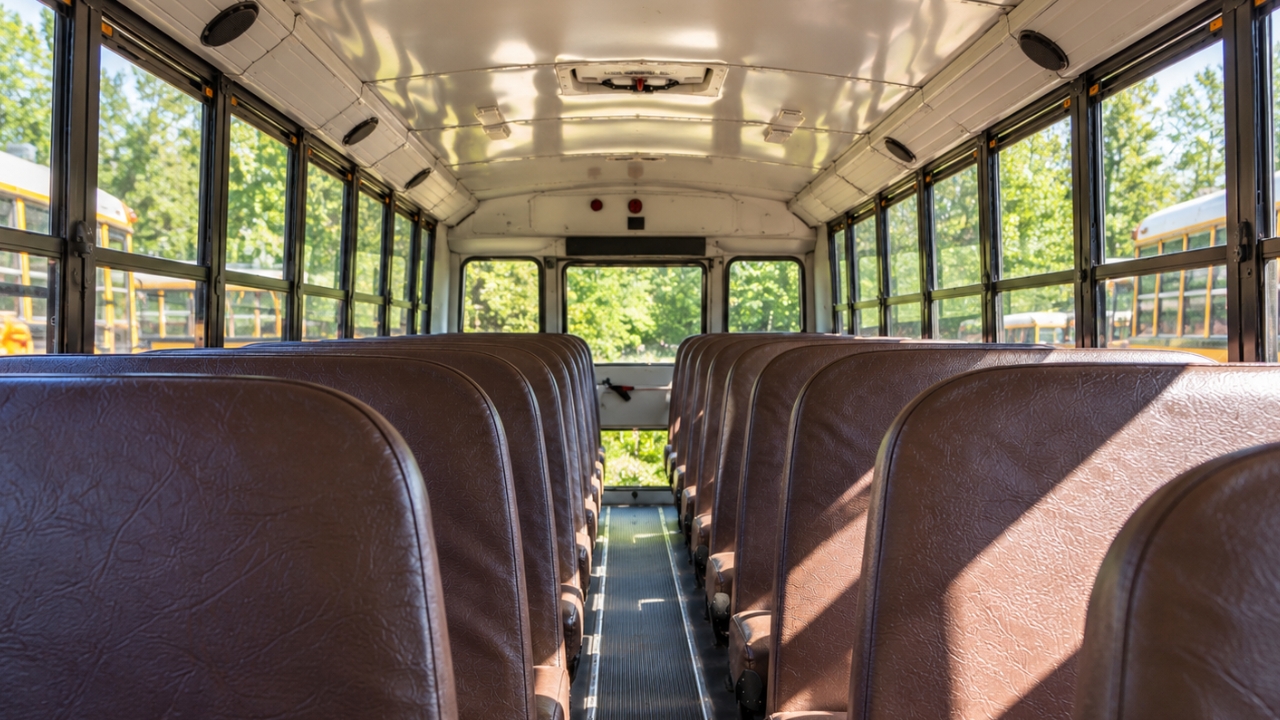
Compared with passenger cars and light commercial vehicles, buses can reduce collision impact intensity because their more robust, heavier metal-frame bodies protect passengers. Although school buses are the most well-known examples of compartmentalized safety design, many of the same safety principles and regulatory exemptions also apply to regular urban buses.
Body Safety Design
The NHTSA believes that the best way to provide collision protection for children on school buses is to adopt a passive restraint system called “compartmentalization”. This system is equipped with protective seats, high collision standards, and rollover protection devices.
Firstly, the school bus seats are specially designed, featuring high backs, wide cushions, and thick, soft seat cushions. The inner part of the backrest is filled with energy-absorbing foam, which can effectively compress during a collision, thereby reducing the impact force transmitted to the passengers and significantly lowering the risk of children suffering from collision injuries.
Secondly, the material of the seat cushions is usually vinyl or leather fabric, with fire-resistant properties, and it complies with strict federal impact absorption requirements under FMVSS No.222. Additionally, the seat frame is fixed to the bus floor through reinforced mounting pieces, capable of withstanding considerable impact forces.
Operating Conditions
The volume and weight of buses are much greater than those of cars and light commercial vehicles. In the event of a collision, their deceleration rate will be much lower than that of passenger cars or small commercial vehicles, and the impact force on the passengers will be significantly smaller, thus resulting in less injury to the passengers.
In addition, buses travel at a slower speed and usually travel on dedicated bus lanes, which can also reduce the accident rate and severity.
Moreover, thanks to their bright yellow body, flashing red warning lights, and retractable parking sign arms, school buses are conspicuous and easily visible to other drivers. This further enhances the safety of the school bus and reduces the likelihood of collision accidents.
 Daily Operational Efficiency
Generally speaking, urban buses have more stops, so the distance for each trip is shorter. As a result, passengers tend to get on and off the bus more frequently. If it is required that every passenger must fasten their seat belts after boarding, then they will need to spend time unfastening the seat belts before getting off, which will reduce the operational efficiency of the bus.
Moreover, many buses allow passengers to stand. So if it is required that every passenger must fasten their seat belts, then standing passengers will no longer be allowed, and the bus’s capacity will significantly decrease, and the efficiency of urban transportation will also be reduced
Emergency Evacuation Safety Risks
Seat belts can affect the efficiency of emergency evacuation. In case of an emergency, the principle is to evacuate passengers from the bus as quickly as possible, which means there should be no time wasted in unfastening the seat belts.
Moreover, jammed or malfunctioning belts may trap passengers during emergency evacuation. Separately, improperly positioned seat belts may increase the risk of severe neck and abdominal injuries, particularly for young child passengers on school buses. You might therefore have to bear huge compensation costs.
According to NHTSA research, available data have not definitively demonstrated that universal seat belts significantly reduce fatality risk in standard school bus crashes.
Installation/Production Cost
If seat belts need to be installed or added, extensive structural modifications will be required, which typically add several thousand dollars in bus seat belt installation cost per vehicle, depending on bus size and retrofit complexity.
Moreover, seat belt hardware, mounting anchors, and structural reinforcements occupy additional cabin space, resulting in a significant reduction in the passenger capacity of each bus.
Therefore, these escalating production costs and the decline in transportation capacity not only fail to enhance the overall safety performance of the vehicles, but also reduce the operational economic efficiency of your vehicles.
Exception Applications: Commercial Bus Seat Belt Requirements
Not all commercial buses qualify for seat belt exemptions.In addition to long-distance coaches, small buses and modified vehicles, regional laws may also require seat belts for school buses and non-Class-I urban buses, which all need fully certified commercial vehicle seat belt systems. The following types of vehicles must be equipped with certified seat belt systems.
Long-Distance Commercial Buses: Highway Speed Seat Belt Requirements
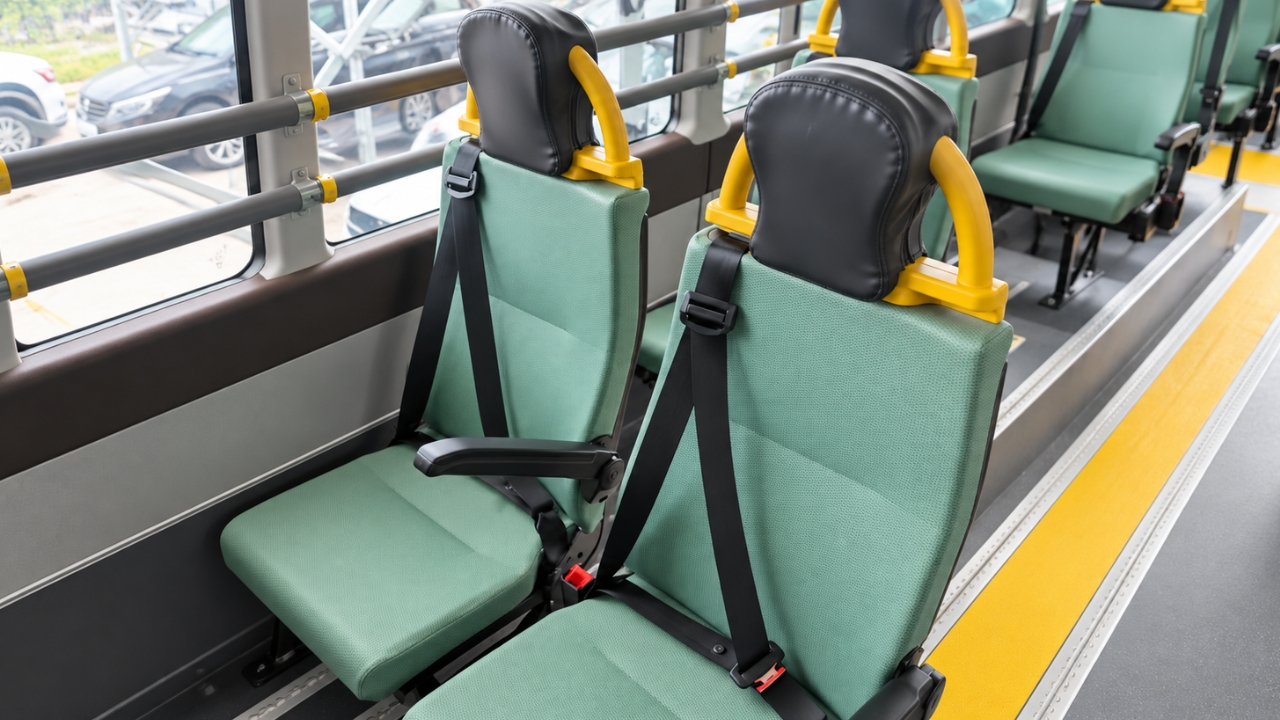
The NHTSA requires that, since November 2016, all new production long-distance motorcoaches and intercity coaches must be equipped with lap and shoulder seat belts for each passenger and driver seat.
Long-distance buses generally travel at higher speeds on highways and have longer trips, so passengers do not frequently get on and off. High speed and long running times significantly increase the risks of rollovers and severe collisions, and the compartmentalization design alone cannot provide sufficient protection.
Therefore, for long-distance coach manufacturers and fleet operators, you should partner with a professional seat belt supplier to access FMVSS 209 / ECE R16 certified seat belts. Mandatory installation of occupant restraints for US motorcoaches is defined under FMVSS 208, while EU vehicle-level installation requirements are covered by ECE R107 and R66, helping you achieve full regulatory compliance.
 Small Passenger Buses: Minibus Seat Belt Requirements
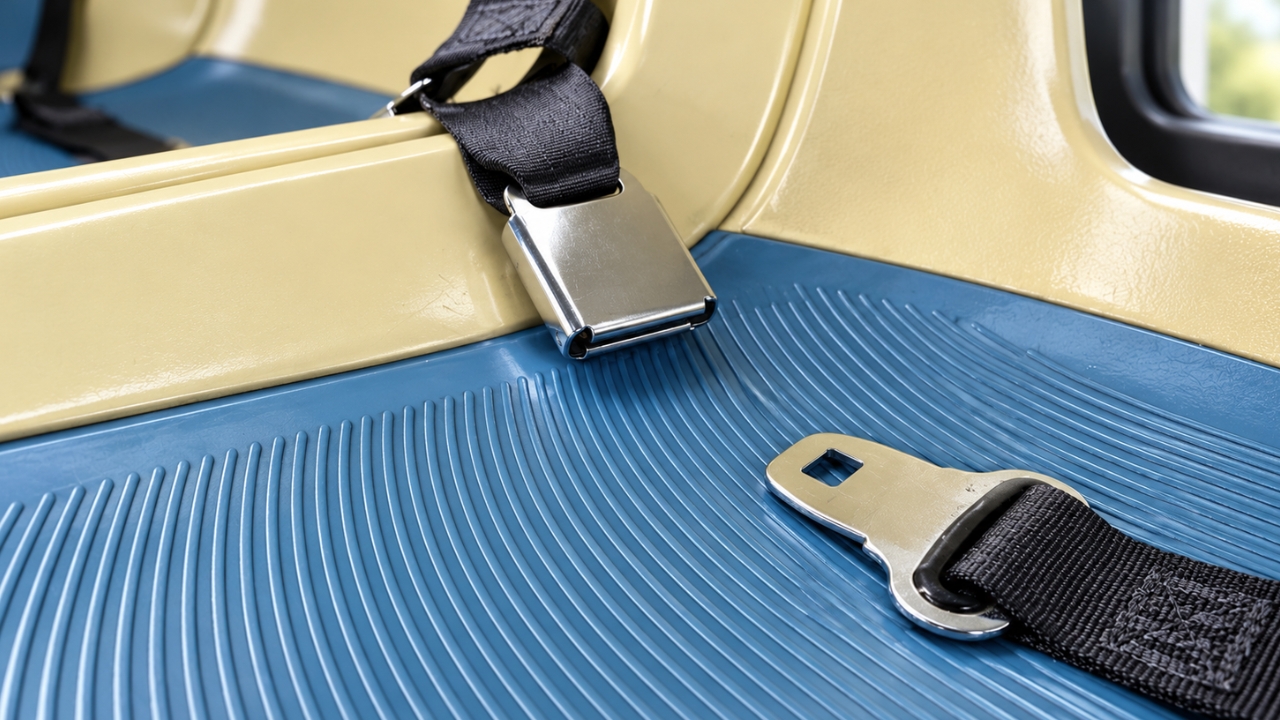
The NHTSA stipulates that all school buses with a Gross Vehicle Weight Rating (GVWR) under 10,000 pounds must install seat belt systems meeting FMVSS 222 vehicle-level restraint requirements, and the belts themselves must comply with FMVSS 209 component standards to meet US federal safety regulations.
Because small buses are lighter in weight, smaller in size, and have simpler structural designs, they lack sufficient shock absorption capacity during collisions and are prone to causing harm to passengers. Therefore, if the weight of your school bus does not reach 10,000 pounds, for the sake of passenger safety and your operating costs, you must install certified seat belt systems to comply with federal safety regulations.
Customized and Modified Buses: Bus Seat Belt Retrofit Rules
Seat belt exemptions only apply to mass-produced, factory-standard city transit buses and school buses built in full compliance with compartmentalization design specifications. All modified, customized, and special-purpose buses are classified as non-standard vehicles and must be equipped with safety restraint systems in accordance with regulations.
We suggest you work with an experienced seat belt supplier to ensure your modified vehicles meet applicable safety standards and pass regulatory inspections without compliance risk.
 FAQ
What Are the Legal Penalties for Operating a Bus Without Required Seat Belts?
The penalty measures vary in different regions and countries, usually including fines, temporary seizure of vehicles, and suspension of operation licenses. In severe cases, the operator is also required to bear legal responsibility for any passenger injuries caused by the violation.
Do Aftermarket Bus Seat Belts Comply with FMVSS No.209 and ECE R16?
Certified aftermarket seat belt systems, when installed by qualified professionals, can fully meet the FMVSS No.209 and ECE R16 standards. However, if you use uncertified aftermarket parts, not only will you fail to meet the compliance inspection requirements, but you will also be subject to regulatory penalties.
Do Bus Drivers Have to Wear Seat Belts Even When Passengers Don’t?
Yes, all traffic regulations worldwide mandate that bus drivers must wear three-point seat belts. If the driver is thrown out of their seat due to a collision, the bus will lose control. The seat belts can secure the driver in their seat, thereby providing valuable time for controlling the vehicle.
Are Double-Decker Buses Legally Required to Fit Passenger Seat Belts?
If it is a Class I urban double-decker bus within a city, it enjoys the same exemption from seat belt requirements as a regular single-decker city bus. Non-Class-I urban double-deckers are not automatically exempt.
Can Installing Seat Belts on Buses Increase Injury Risk in Some Crash Types?
Yes, in some crash types, installing seat belts on buses can increase the risk of injury. If a bus undergoes a severe frontal collision, lap belts may increase the risk of neck injuries for young passengers and even cause abdominal injuries.
Final Thoughts
Whether or not buses are equipped with seat belts depends on the type of vehicle, the operating environment, local safety regulations, and the cost budget. Contact us if you need support with seat belt regulatory compliance or bulk supply; Bxseatbelts can offer you tailored safety solutions.