

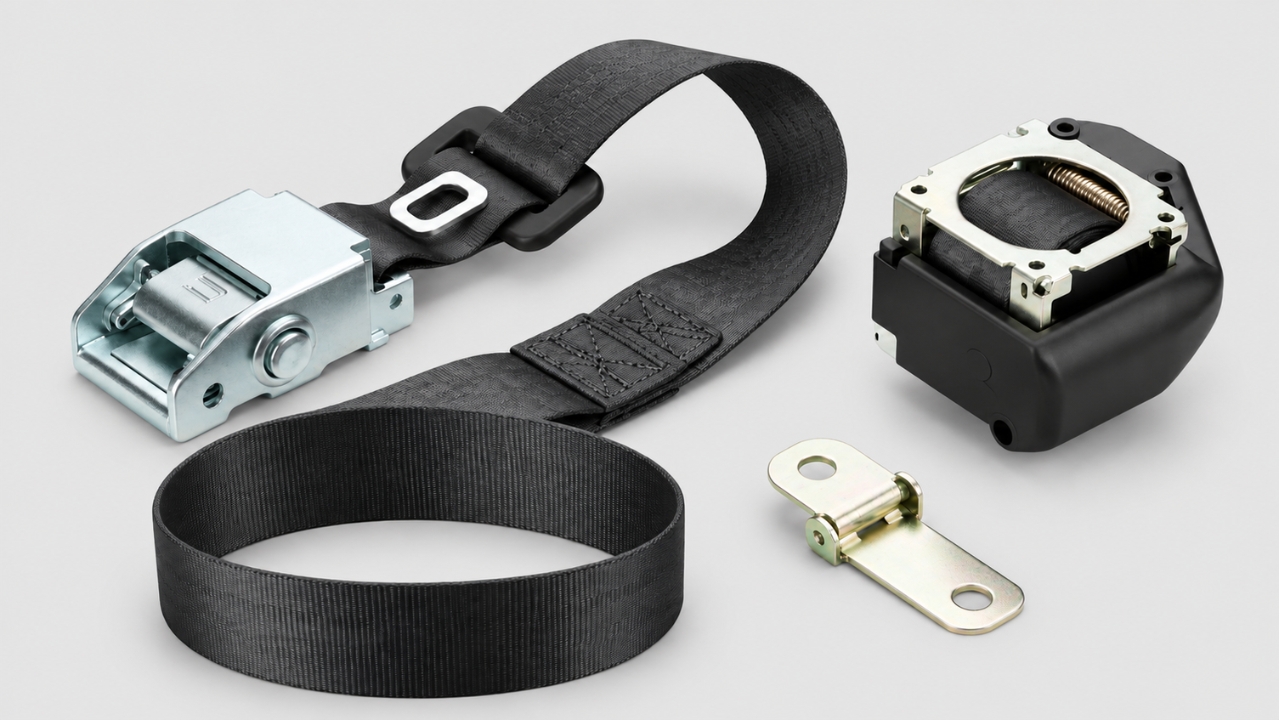
Automotive seat belt design involves selecting and matching webbing, retractors, buckles, and mounting components. Vehicle type, seat layout, and installation conditions all influence component selection, system configuration, and performance requirements.
For automakers, distributors, and importers, understanding these factors helps with product evaluation, sample approval, and supplier selection. This article examines the main components of a seat belt assembly, application-specific design considerations, and key points to review when sourcing seat belts.
 Core Components of Automotive Seat Belts
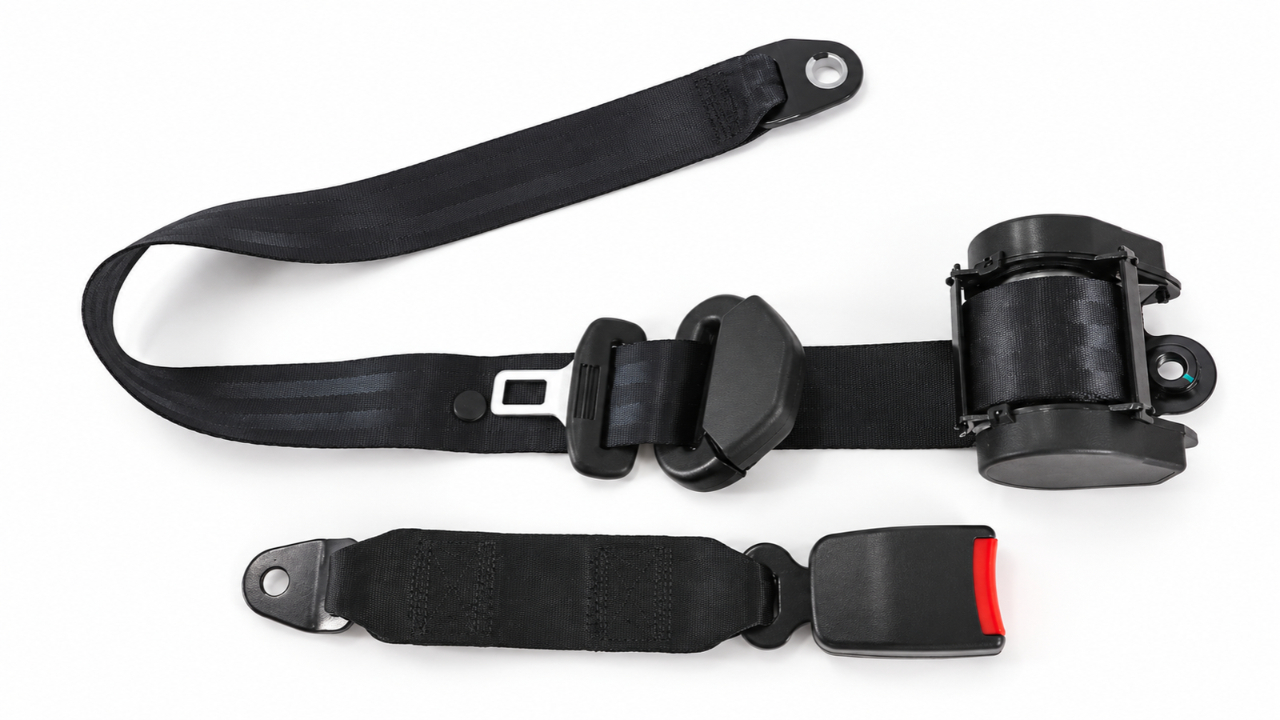
Seat Belt Webbing
It is a critical component that transmits restraint loads within the seat belt assembly.
- Material: Automotive seat belt webbing is generally made of high-strength polyester fibre. Its tensile properties, dimensional stability and resistance to environmental ageing help meet requirements for long-term vehicle use.
- Width and Thickness: Webbing dimensions shall comply with project specifications and be compatible with retractors, guides and other associated parts.
- Mechanical Properties: Indicators such as tensile strength and elongation shall satisfy project technical specifications and corresponding test requirements.
- Durability:Abrasion resistance, colour fastness, and resistance to ageing affect the webbing’s ability to retain its properties during long-term use and environmental exposure.
When selecting webbing, material and width alone are not sufficient. Indicators including tensile strength, elongation and wear resistance must be evaluated against product specifications and relevant test results.
 Seat Belt Retractor
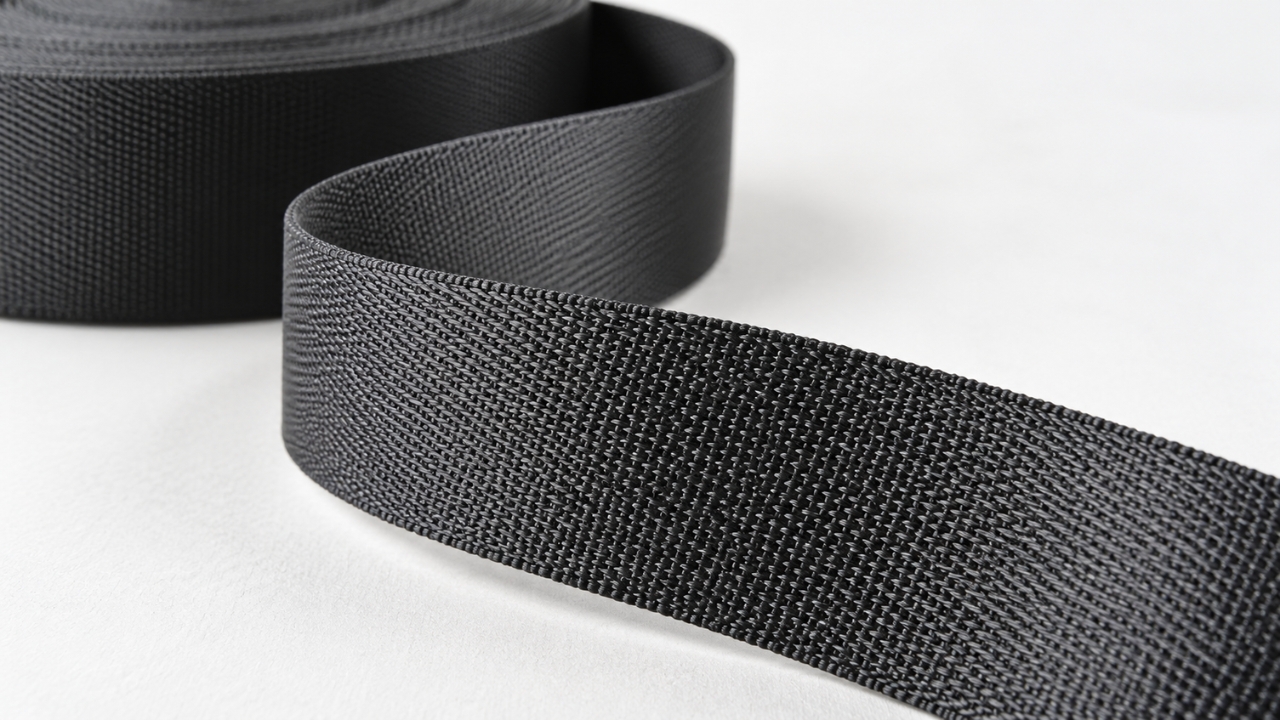
The seat belt retractor stores and releases the webbing, providing sufficient retraction force during normal use. Under specified conditions, its locking mechanism prevents further webbing payout.
An Emergency Locking Retractor (ELR) allows webbing payout during normal use and locks under defined emergency conditions. An Automatic Locking Retractor (ALR) is designed to lock the webbing automatically under specified operating conditions. Its engagement procedure and intended application should be verified against the manufacturer’s technical documentation.
Retractors with similar appearances may differ in internal structure, mounting requirements and operating characteristics. During procurement, verify the part number against mounting orientation, locking mode and intended application; suitability cannot be judged by appearance alone.
Seat Belt Buckle and Tongue
The buckle and tongue form the latching interface of the seat belt assembly. Inserting the tongue into the buckle fastens the seat belt, while the release mechanism unlocks it when needed.
Buckle design must ensure reliable latching and smooth release of the tongue, and accommodate the mounting layout of seats and vehicle body. The tongue and buckle must be evaluated as a matched set. Interface dimensions, mounting methods and durability test results shall align with project requirements.
This is especially important when purchasing replacement parts. Always cross-check the exact part number and matching relationship; similar shape does not guarantee direct interchangeability.
Pretensioner and Load Limiter
These are supplementary safety mechanisms fitted on some seat belt systems. They perform distinct roles in a crash, and their design must work in coordination with other parts of the restraint system.
- Pretensioner: Rapidly takes up webbing slack when triggered by the system to reduce the gap between occupant and seat belt. It can be integrated into retractors, buckles or other locations.
- Load Limiter: Limits the load exerted by the seat belt on the occupant in a predefined, controlled manner.
The operating characteristics of both components must match the overall vehicle restraint system.
 Seat Belt Anchorages and Mounting Components
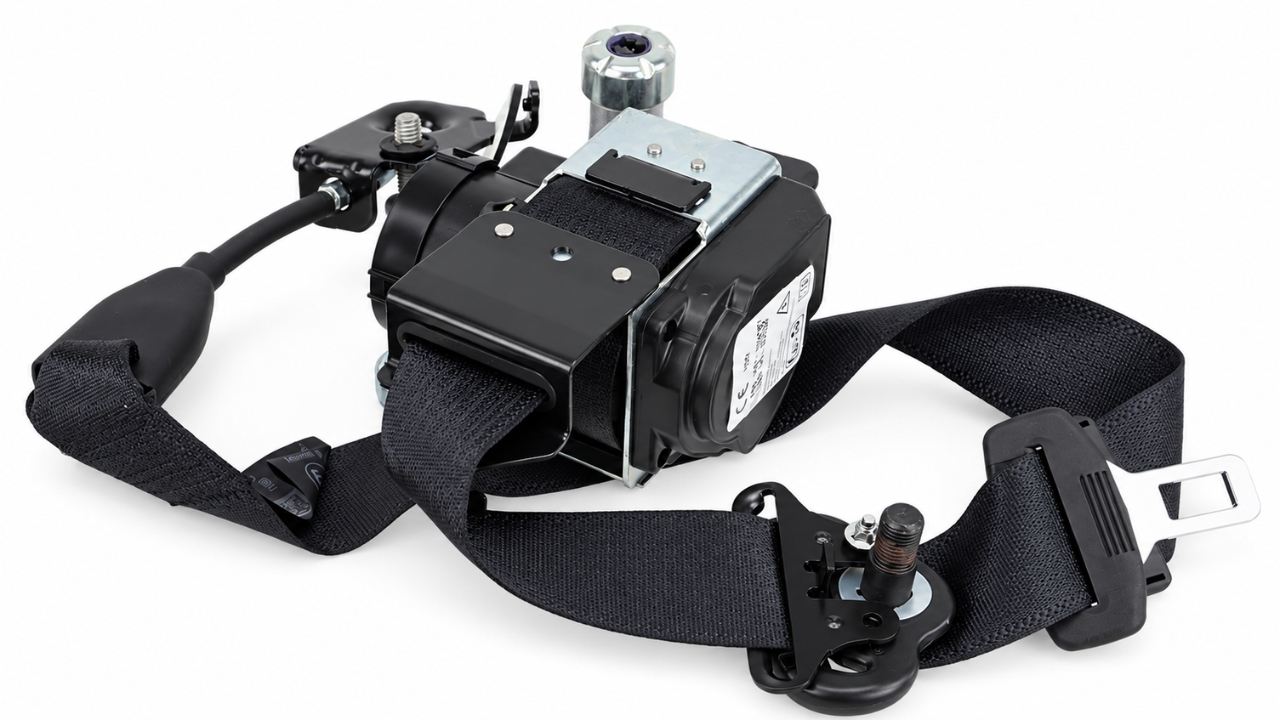
They connect the seat belt assembly to the vehicle body or seat structure. Their positions and connection methods influence the load transfer path. Design evaluation considers installation space, seat or body structure, together with the strength and fastening method of connecting parts.
When sourcing fasteners, check not only dimensional consistency but also whether material, connection structure and assembly requirements conform to the specified design. Compliance of a single bolt or bracket with its own technical criteria does not mean the complete seat belt mounting system has passed validation.
Application Scenarios
| Application Scenario | Design Focus | Points to Confirm During Procurement |
| Passenger Cars | Different front and rear seat layouts affect retractor mounting positions, webbing routing and buckle arrangement. | Confirm part numbers for front and rear seats, retractor mounting orientation, webbing length, buckle interface, and compatibility with seat and body anchor points. |
| Commercial Vehicles | Driver seats and installation space may differ from passenger cars. Vehicle vibration and service frequency also influence component selection and durability assessment. | Confirm installation space, fixing method, webbing wear resistance, retractor retraction and locking characteristics, plus maintenance and replacement requirements. |
| Buses and Coaches | Seat layouts, seat structures and anchor point positions vary between seating positions. Seat belt configurations shall be defined per seat and vehicle design. | Confirm seat belt configuration for each seating position, webbing length, buckle mounting method, anchor point design, and applicable regulations and test requirements. |
| Special-Purpose Vehicles | Non-standard seats may be used, and layout of surrounding equipment can impose space constraints. Check actual installation space and extra environmental requirements for components before selection. | Confirm custom dimensions, connection interfaces, installation space, environmental adaptability requirements, and validation tests carried out for the specific application. |
Key Considerations for Seat Belt Design and Selection
- Technical Specifications: Define the required webbing parameters, retractor performance, buckle interfaces, and mounting requirements. Check them against the project’s technical specifications.
- Component Matching: Verify compatibility among the webbing, retractor, tongue, and buckle. Similar appearance or dimensions do not guarantee interchangeability.
- Installation Conditions: Review retractor orientation, anchorage locations, brackets, and seat structure before assembly.
- Testing and Regulations: Identify the requirements applicable to the target market and vehicle application. Individual component test reports do not replace any required assembly-level or vehicle installation validation.
- Customisation and Supply: For changes to dimensions, colours, or mounting interfaces, establish the sample development schedule, validation timeline, production plan, and supply capacity in advance.
 FAQ
What Quality Documents Should I Request from the Seat Belt Supplier?
Seat belt component suppliers shall provide relevant quality and technical documents based on product type, customer requirements and target market, to help buyers verify product specifications, production quality and compliance. Common documents include:
- Product Specifications: Confirm part number, dimensions, materials and technical parameters.
- Product Test Reports: Review test items, test standards, test results and corresponding part numbers.
- Quality Management System Certificates: Such as ISO 9001 and IATF 16949 certificates; check scope of coverage and validity.
- Material Certificates: Verify relevant specifications and supporting documentation for materials.
- Batch Inspection Records: Review inspection results for specific production batches.
- Compliance Documentation: Provide relevant regulatory, certification or conformity documents according to target market and product scope. (For the US market, confirm applicable regulations based on product type and application. For example, FMVSS 209 covers requirements for seat belt assemblies, and FMVSS 210 covers seat belt anchor points. Always verify applicable clauses, vehicle categories and the latest regulatory version for each project.)
During procurement, do not merely check whether documents are complete. Confirm that the part numbers, specifications, test standards and validity stated in documents match the products ordered. A test report for a single component or a supplier’s quality system certificate does not fully guarantee that the complete seat belt assembly or in-vehicle system meets all safety requirements.
What Information Should I Provide When Requesting a Quotation?
Product type, application scenario, technical specifications, mounting dimensions, estimated order quantity, target market, and whether customisation is required. Drawings or samples, if available, can also be shared with the supplier for evaluation.
How Can I Ensure That a Seat Belt Design Meets the Required Technical Specifications?
First confirm key performance indicators, applicable standards and acceptance criteria in the technical specification, then review drawings, product datasheets and test reports provided by the supplier. For new development or revision projects, also confirm component matching, installation fit and completion of necessary system validation, and retain relevant approval and test records.
For safety-critical parts such as seat belts, compliance of the whole system cannot be assumed based only on supplier declarations or single-component test results.
What Is the Development and Approval Process for Seat Belt Samples?
Sample development and approval for seat belts generally cover requirement confirmation, sample fabrication, sample testing, customer evaluation and final approval. The typical workflow is as follows:
- Confirm project requirements
- Develop and produce samples
- Carry out sample testing
- Submit for customer evaluation
- Revise and reconfirm
- Sample approval and mass production release
What Should I Verify Before Approving a New Seat Belt Supplier?
Before approving a new seat belt supplier, buyers should assess its project development capability, quality control level and consistent supply capacity, rather than only checking product documentation.
- Development Capability: Confirm whether the supplier can carry out product selection, specification adjustment, interface matching and required customisation per project requirements.
- Sample Validation: Evaluate sample dimensions, performance and installation fit, and confirm completion of required testing and approval.
- Quality Control: Understand the supplier’s production inspection process, non-conforming product handling procedures and batch traceability.
- Production Capacity: Verify production equipment, output, control of key processes and consistency in mass production.
- Delivery & After-Sales Support: Confirm lead time, order responsiveness, non-conformity handling procedures, and whether ongoing technical support can meet project needs.
Final Thoughts
If you are looking for seat belts or related components for a specific vehicle model, feel free to contact us. Share your technical requirements and application needs, and we can help confirm the right product configuration for your project.