


Using non-compliant seat belts will lead to failure of certification audits, prohibition of market access, and significant business losses. This article provides a detailed introduction to the seat belt regulations in the major global markets and the compliance requirements that must be followed, helping your sourcing of compliant seat belts.
Why Does Seat Belt Legality Matter?
Seat belts are the most effective safety technology in automotive history. They are certified life-saving components, designed to meet the precise stretching loads, elongation limits, and wear resistance thresholds stipulated in the federal motor vehicle safety standards.
Unlike decorative accessories, the webbing is an indispensable part of the entire restraint system: its strength, energy absorption capacity, and compatibility with the retractor and pretensioner directly affect the collision performance. However, if they do not comply with relevant regulations, it may cause the entire seat belt to fail during a collision.
 Key Global Seat Belt Standards for Automotive Exports by Major Markets
There is no universal seat belt standard worldwide. The regulatory entry rules and specific indicators vary in different markets. If you choose a seat belt that does not comply with the regulations of your region, you will not only face the failure of the audit and certification, but also delay your project progress and incur unnecessary operational losses.
The following are the seat belt legislation in the major global markets:
North America: Dual Standard System of FMVSS No.209 and CMVSS
The North American region is one of the most rigorously regulated markets for automotive seat belt assemblies globally, forming a dual standard system of the US federal standard and the Canadian national standard.
U.S. Federal Requirements: FMVSS No.209 Seat Belt Requirements
FMVSS No.209 is the federal mandatory safety standard for seat belt assemblies in the US. It is a regulation formulated by the US National Highway Traffic Safety Administration (NHTSA) regarding the performance, labels, and certifications of seat belt components. If you violate this standard, you will face a civil fine of up to $23,140 for each non-compliant vehicle sold. Intentional falsification of certification documents or fraudulent non-compliance that leads to injury may also trigger criminal liability under US federal law.
- Webbing Performance: The minimum tensile strength of lap belt webbing is 22,240 N (5,000 lbf) and that of shoulder belt webbing is 13,344 N (3,000 lbf). After standard reciprocating abrasion testing, the webbing residual strength remains ≥ 75% of the original strength.
- Retractor Performance: The emergency locking retractor (ELR) must fully lock when the webbing extension is no more than 25mm under an acceleration of 0.45 g- 0.7 g per FMVSS No.209 test procedures.
- Buckle Performance: The buckle has not shown any signs of wear or looseness after 5,000 opening and closing cycles.
- Environmental Tolerance: The seat belt must pass a 168-hour humid heat aging test under 38℃ and 95% relative humidity conditions to avoid performance degradation.
Canada: CMVSS Standards
Canadian CMVSS standards are largely aligned with US FMVSS baseline requirements, but they have added additional legislative clauses for seat belts for commercial vehicles and school buses.
- Commercial vehicle seat belts require a 15% higher tensile strength margin.
- School buses must use thicker seat belts, anti-pinch locks, and smooth damping retractors.
- Replacement parts must be 100% matched with the parameter specifications of the original factory components. The use of universal non-standard modification parts is prohibited.
Europe: ECE R16 Seat Belt Compliance & EU GSR Framework
The European Union implements an automotive safety standard system centered on the ECE R16 core law, combined with the EU GSR vehicle entry regulations.
ECE R16
ECE R16, officially ECE Regulation No. 16, is a core technical standard for seat belt assemblies under the framework of the United Nations Economic Commission for Europe (UNECE), including all mechanical parameters, locking mechanisms, and vehicle entry regulations.
Webbing Performance
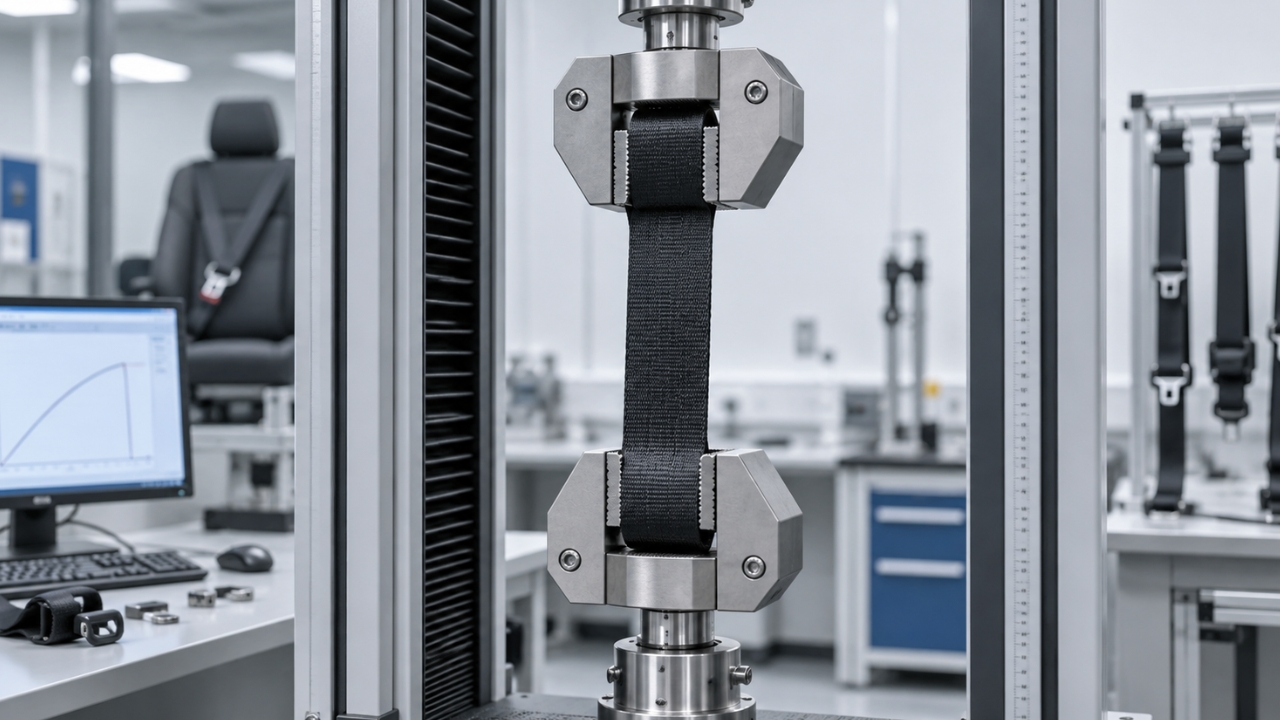
- Stretch the webbing until it breaks. The minimum breaking strength of the lap belt must be ≥ 22 kN, and that of the shoulder seat belt must be ≥ 15 kN. The elongation at break must be between 10% and 25%.
- After being exposed to 150 hours of xenon lamp irradiation, the webbing shows no obvious fading or brittleness, and the residual strength must be more than 80% of the original strength.
- After the seat belt webbing undergoes 5000 repetitive friction cycles, residual strength retention after abrasion shall be ≥ 80%.
Retractor Performance
- The emergency locking retractor (ELR) shall trigger locking at a deceleration of 0.45 g–0.7 g in the webbing payout direction.
- The retractor shall not lock incorrectly within an inclination angle of 12°. When the inclination angle is greater than 27°, the retractor must be able to achieve reliable locking.
- The retractor functions normally after completing 5000 full-stroke extension and retraction cycles, with no abnormal wear.
Buckle Performance
- The front seat buckles supports one-handed, one-directional, one-click unlocking, and the unlocking force must be maintained within the range of 10-60 N;
- The buckles can only be in two states: “fully locked / fully open”, and no intermediate transitional state is allowed to avoid potential safety hazards;
- For passenger vehicles, the buckles should not fail after 5000 opening and closing cycles, while for commercial vehicles, the buckles is required to complete 10000 opening and closing cycles without failure;
- After bearing a load of 22 kN, the buckles should not break or have structural failure.
Environmental Tolerance
The seat belt maintains stable performance after being subjected to cyclic temperature changes ranging from -40℃ to +80℃.
 EU GSR
The EU General Safety Regulations for Complete Vehicles (GSR) are the top-level rules for new vehicle entry. They build upon ECE R16 and add requirements for vehicle certification, mandatory configuration for specific vehicle models, and post-sale control.
- All seat belts in new vehicles must be mandatory to carry the E-mark certification logo.
- Passenger buses and heavy-duty trucks must be equipped with force-limiting retractors and pre-tensioner assemblies.
- Replacement parts must not be inferior to the original factory design parameters and must possess a complete E-mark certification.
Asia-Pacific Region: Diverse National Standards Coexist
There is no unified seat belt regulation in the Asia-Pacific region. China, Japan, and Australia have their own independent seat belt regulation standards, but the basic performance parameters can be benchmarked against ECE R16 or FMVSS No. 209. The entry threshold in Southeast Asia is more lenient. On the basis of integrating international standards, additional local requirements have been added.
 China: GB 14166-2013
The current seat belt national standard in China, with the basic indicators consistent with ECE R16, but placing greater emphasis on domestic vehicle durability and dust environment tests.
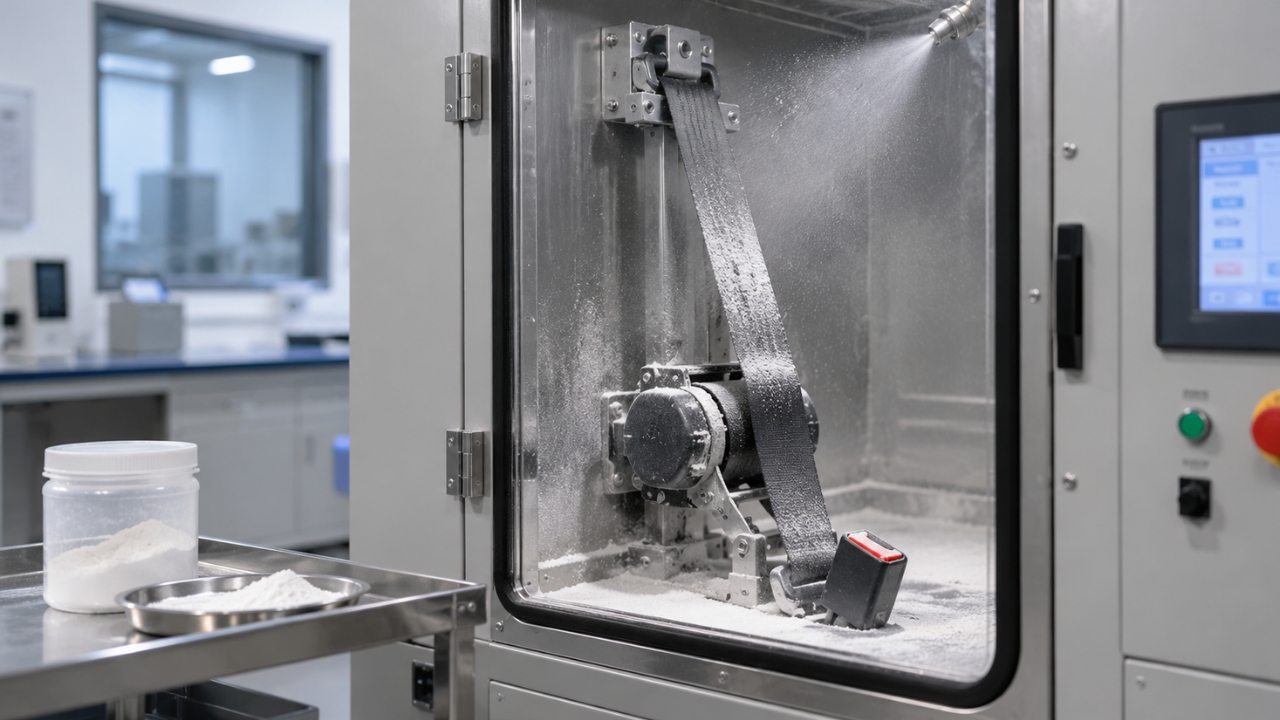
- After the seat belt and components are placed in an environment containing talcum powder for 50 hours, the locking and retraction functions of the retractor are normal;the webbing flame retardant performance meets the requirements of GB 8410, with a burning rate ≤ 100 mm/min.
- Market entry must carry the CCC certification mark and must clearly indicate the standard number, production batch, and manufacturer information.
Japan: JIS D 4604
Japanese Industrial Standard for Motor Vehicle seat belts. The basic safety indicators are benchmarked against ECE R16, focusing on silent and flexible testing, and the high humidity and weathering standards are more stringent. Special tests for mold prevention and corrosion prevention have been added.
- The bending stiffness of the webbing is ≤ 1.5 N·cm, improving the body fit; the unlocking force of the lock is 10–50 N, and the operation noise is ≤ 55 dB; the difference in pull-out / retraction force values of the retractor is ≤ 2 N, and the retraction and extension are smooth.
- After the seat belt webbing is placed in a 50℃, 95% relative humidity environment for 240 hours, no mold has occurred, and the strength loss must be ≤ 15%.
Australia: ADR 4/06
Australian Motor Vehicle Design Rules No. 4, with the basic indicators benchmarked against the US FMVSS No.209. To adapt to the local dusty and strong sunlight outdoor conditions, more emphasis is placed on dust tolerance and anti-aging performance tests.
- After the retractor is tested in a 50 g/m³ dust environment for 10 hours of cyclic testing, the retractor has no jamming and the locking function is normal; after 1000 hours of UV exposure, the webbing does not show cracking, fading, etc., and the residual strength must be maintained at≥ 75% of the original strength.
- Pure E-mark certification is not accepted; an ADR compliance report from an Australian local recognized laboratory must be provided.
Southeast Asian Market: General Entry Requirements
Most Southeast Asian markets adopt national standards equivalent to ECE R16 or GB 14166, with additional localized environmental requirements for tropical climates. The basic performance meets the requirements of ECE R16 or GB 14166. However, for the local humid, hot, and salty climate, there are higher requirements for the anti-corrosion and anti-mold performance of the seat belt.
- The metal components must not show red rust on the surface, or the coating must not fall off after 96 hours of continuous salt spray testing in a 5% sodium chloride solution at 35°C; after 28 days of mold culture, the mold area must be ≤ 10%.
- The deviation between product parameters and certification documents must be controlled within 5%, and exceeding this range will directly result in customs rejection.
Middle East and Africa: Regional Unified Standards & Differences in Entry Requirements
The regulatory frameworks in the Middle East and African markets vary significantly. The Gulf countries have a unified GSO standard with similar thresholds to those in Europe and the United States; the core markets in Africa adopt international common standards and strictly verify the authenticity of the parameters.
Gulf Standardization Organization: GSO 422
The unified seat belt standard (GSO 422) issued by the Gulf Standardization Organization, with basic performance parameters benchmarked against ECE R16, and additional stringent high-temperature weathering and aging tests are added for the Gulf’s desert and high-temperature climate.
- After being placed in a 90℃ environment for 240 hours and subjected to high-temperature baking, the retention rate of the webbing strength is ≥ 80%, the damping change of the retractor assembly is ≤ 20%, and the unlocking force change of the lock is within ± 20%.
- After 1200 hours of UV exposure, the webbing shows no cracking or obvious fading.
- Non-standard, refurbished, or re-repaired components are strictly prohibited from entering the market, and the qualification verification of replacement parts for after-sales services is rigorous.
Mainstream African Markets: General Entry Requirements
The core markets in Africa generally adopt the dual standards of ECE R16 and FMVSS No.209, with relatively relaxed entry thresholds.
However, the African market will strictly verify the authenticity of component parameters such as the nominal webbing strength and the locking reliability of the retractor assembly. The deviation from the measured values shall not exceed 10%, and non-standard modifications are not allowed. Failure to pass parameter authenticity checks will damage your company’s reputation and market access in African markets.
 How to Achieve Full Global Seat Belt Legislative Compliance?
After thoroughly understanding the specific testing standards and qualification parameters of seat belt regulations in each region around the world, correct selection of seat belts and components, document verification, and cross-functional checks will help you avoid certification failures and save post-sale costs. Follow these four core steps to achieve full seat belt compliance for automotive exports:
Align Specifications with Target-Market Rules and Vehicle Type
Before selecting a supplier, you need to be clear about the seat belt regulations in your region. For example, the North American market needs to comply with FMVSS No.209, the European market needs to comply with ECE R16 and EU GSR, and the Chinese market needs to comply with GB 14166.
In addition, you need to clearly identify the vehicle models to which your seat belts are applied, as the compliance requirements for different vehicle models vary. If you are unclear or confused about the compliance requirements for each vehicle model, it will lead to compliance risks for your vehicles and increase your production costs.
Require Accredited Test Reports and Valid Certification from Suppliers
You need to request the supplier to provide complete test reports covering webbing, retractor, lock, and environmental tolerance performance, carefully confirm each test data, ensure that the certificates match your part number and vehicle application exactly, and avoid seat belts failing the compliance certification.
In addition, you need to confirm the corresponding qualification certification documents for your market, such as the CCC mark and ADR test report. Do not reuse certificates across standards or forge documents; otherwise, you will face legal penalties and affect your enterprise reputation.
Enforce Mass Production Batch Consistency Control
Batch performance drift is one of the most common compliance risks in mass-produced seat belt assemblies, driven by raw material variations, weaving tension differences, and assembly process adjustments. You should never approve large-volume production orders solely based on prototype qualification test reports.
Instead, you need to establish fixed batch sampling rules and focus on testing the residual strength retention rate, the locking accuracy of the retractor assembly, and the durability of the buckle. Moreover, if the supplier needs to adjust production, you must require them to report to you; otherwise, the existing certification will become invalid.
Secure Traceability and Define Compliance Liability in Purchasing Contracts
We recommend that you keep the test archives and certification documents of each production batch to facilitate regulatory audits. You should preferably clearly define the liability for non-compliance risks in the procurement contract. Otherwise, as a seat belt purchaser, you will bear the main losses and legal responsibilities.
If you need to modify or replace seat belts, you must ensure that the performance and certification level of the replacement parts are not lower than the original factory standards. You must re-certify the replacement parts; otherwise, you will bear a huge economic penalty.
 FAQ
When Are Aftermarket Seat Belt Legal Requirements Violated Under FMVSS No.209 Standard?
If any of the following situations occur with your aftermarket seat belt, it violates the FMVSS No. 209 Standard:
- Aftermarket seat belts fail to meet mandatory component rules set by NHTSA.
- You will lose valid certification if you install unmarked belts, generic universal kits, or modified OEM assemblies with altered webbing or anchor points.
- Seat belts missing production date codes or traceable markings also count as non-compliant parts for road vehicles.
- Foreign manufacturers must appoint a US legal agent; products without this representation cannot satisfy FMVSS No.209 entry requirements.
What Are the 2026 Updates for Seat Belt Certification for Automotive Exports?
2026 global updates tighten seat belt certification thresholds: FMVSS No.209 adds combined thermal cycling, extra durability cycles, an 82% residual strength requirement, and dynamic impact testing; ECE R16 upgrades commercial vehicle buckle durability and half-lock detection; Australia raises UV aging standards for NEVs, with full lifecycle traceability enforced across all export markets.
Does Seat Belt Legislation Apply Differently to Mass Production and Small-Batch Custom Vehicle Orders?
No, regardless of the size of the order, all vehicles must comply with all standards in major markets.
However, according to FMVSS regulations, manufacturers with an annual production volume of less than 10,000 units can adopt a simplified type approval process.
Under ECE rules, small-series vehicles may also apply for simplified certification, but seat belt performance must still fully meet ECE R16 requirements.
Can One Set of Seat Belt Certification Satisfy Both EU ECE and US FMVSS Legislation?
No single certification standard satisfies both the ECE R16 standard and the FMVSS No.209 standard. These two standards differ in terms of testing methods, locking thresholds, aging parameters, and certification rules, and cannot be mutually recognized. Therefore, if your seat belt is sold in both North America and Europe, independent testing is required.
What Seat Belt Legislation Applies to Electric Vehicles (EVs) and New Energy Commercial Vehicles?
EV and new energy commercial vehicle seat belts build on mainstream regulations with targeted enhancements per global EV safety codes:
- Upgraded flame-retardant webbing is required for battery fire risk mitigation in enclosed EV cabins.
- Enhanced high-low temperature cycle stability is mandated to match the wider operating temperature ranges of EV powertrain systems.
- Per EU GSR and major national NEV safety rules, commercial new energy vehicles must be fitted with mandatory pre-tensioners and force-limiting retractors as standard.
Final Thoughts
Compliant seat belts depend on target market legislation, the vehicle model and application, supplier’s certification qualifications, and product traceability. Contact us if you are sourcing fully certified global-standard seat belts. Bxseatbelts can provide you with a one-stop service from production to maintenance.